The site work division of ICFHome.ca · Building since 1979 · Insured to $2,000,000 · 705-533-1633

Wet Basement2026Tiny, Tay, Midland, Wasaga, Collingwood
Water in the Basement After Rain? Check the Grading First
If water shows up only after rain or snowmelt, the cause is usually outside: downspouts dumping at the wall, ground that slopes toward the house, or backfill that has settled. Check them in the order below, cheapest first, before you pay anyone to dig up your foundation.
Updated October 2026 · Georgian Bay Siteworks, the site work division of ICFHome.ca
Insured to $2,000,000Site work division of ICFHome.caBuilding since 1979250+ projects in Simcoe County
Start With the Timing
Water that appears a few hours after a storm and dries up in a day or two is surface water finding its way in. Water that sits there for weeks, or comes up through the floor every spring whether it rains or not, is more likely ground water. The fix for the first is usually a shovel and some downspout pipe. The fix for the second is a lot more money.
So before anything else, note when it happens, where on the wall or floor it shows up, and what the weather did in the 24 hours before. Take a photo with the date on it. You will use this later.
Builder truth: a basement does not leak at random. Water takes the easiest path, and that path usually starts at the bottom of a downspout.
The Diagnosis Order (Cheapest First)
- Downspouts. Go out in a good rain. If a downspout ends at the wall, or the extension has been kicked off by the lawn mower, you have probably found your leak. Carry the water at least 2 m from the foundation, which is what the Intact Centre basement flood checklist recommends. Clean the eavestroughs while you are up there.
- Slope of the ground. Lay a 3 m (10 ft) straight board out from the wall with a level on it. The ground should drop away from the house. The common rule of thumb comes from the US residential code, which asks for a 6 inch fall in the first 10 feet, about 5%. Ontario grading plans set their own numbers; Tiny’s procedure asks for at least 2% away from buildings. Flat or sloping in means water sits against the wall.
- Backfill settlement. The soil pushed back against a new foundation settles for a few years after the house is built. A low trench along the wall is the classic sign. It catches water like a gutter and feeds it straight down the outside of the wall.
- Window wells. A window well full of leaves, or one that sits level with the lawn, fills up like a bucket and leaks through the window frame. The Intact Centre suggests wells 10-15 cm above ground and sealed to the foundation. A clean well with a cover fixes a surprising number of “basement leaks.”
- Swales and the bigger picture. Stand back and look at where water comes from. A neighbour’s yard, a driveway or a road can send water toward your house. A swale along the side or back of the lot carries it around. If water is crossing from next door, read neighbour water draining onto your property.
- Sump pump discharge. If you have a sump, follow the discharge line outside. If it empties right beside the house, the same water goes around and around, and the pump runs all night. Send it out to a swale, dry well or a spot that drains away from both your house and the neighbour’s. In Tiny, the Township’s April 2026 public works notice says sump pumps and other private drainage must not be discharged into the road or municipal storm network, and its grading procedure says discharge to a municipal ditch is prohibited.
Steps 1 to 4 cost the least and cover the most common causes. Do them before you call anyone with a jackhammer.
What the Fixes Look Like
Downspout extensions or buried lines
Above-ground extensions cost a few dollars each. Buried solid pipe to daylight or a dry well looks tidier but must slope the whole way, or it freezes solid in winter.
Regrade the band around the house
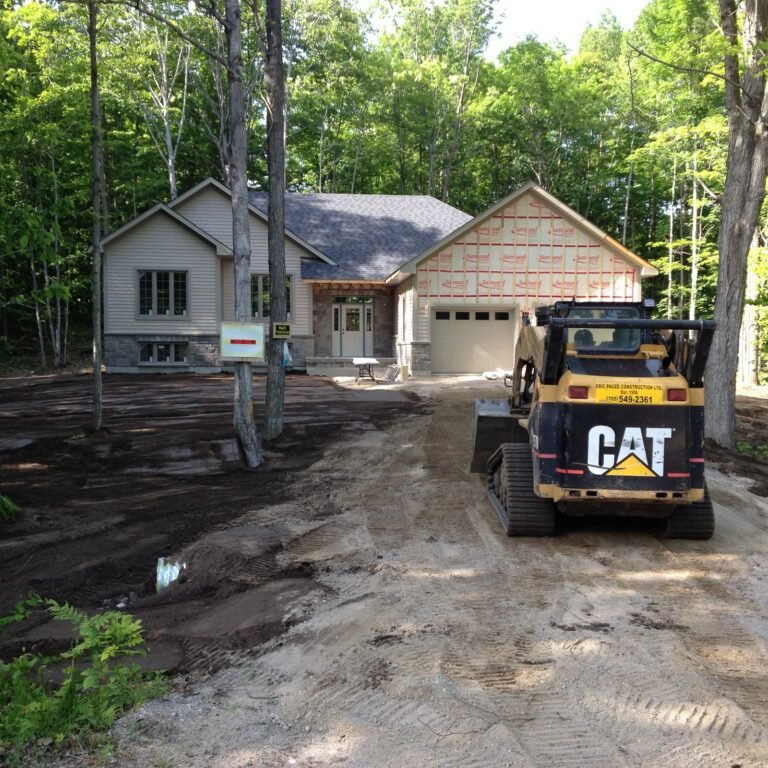
We bring in clean fill, compact it, slope it away and top it with topsoil. Keep the finished grade below the siding; Wasaga’s checklist asks for at least 150 mm.
Swale or French drain
A swale moves surface water around the house. A French drain collects soggy ground water. Both need somewhere lower to send it.
Window well clean-out and covers
Cheap, quick, and often overlooked. Check that the well has stone at the bottom and is not packed with soil.
Rough costs for each are on our grading and drainage cost page.
When It Is Not the Grading
Sometimes the outside is fine and the water still comes in. Here are the signs you need a different trade.
- Water through a crack in the wall or floor. If one crack leaks every time, a foundation repair company should look at it. Grading helps, but it will not seal a crack.
- Water up through the floor every spring. Near the Bay in Tiny and Wasaga the water table can be high. If water rises through the slab when the ground is saturated, you are looking at the weeping tile, the sump and possibly an interior drainage system.
- Water only in one corner, under a plumbing line. Check the plumbing first. A leaky hose bib or a sweating cold water line can fake a grading problem very convincingly.
- Damp walls, no puddles. That can be condensation. Run a dehumidifier for a week and see if it changes.
- Sewer smell or water from the floor drain. That is a sewer or septic issue, not grading.
Building new? An ICF foundation with good drainage detailing and proper grading from day one is the cheap way to never read this page again. Our parent company, ICFHome.ca, builds that way.
Builder truth: fix the outside before you pay for the inside. Interior waterproofing deals with water that already got in. Grading keeps it from getting there.
Book a Drainage Walk-Around
Send us your dated photos and a note on when the water shows up. We will walk the lot, check the slopes and tell you what we would fix first, and what we would leave alone.
Related guides
Frequently Asked Questions
Why does my basement leak only after heavy rain?
Usually because surface water is collecting against the foundation. Downspouts ending at the wall, ground sloping toward the house and settled backfill are the most common causes.
How much should the ground slope away from my house?
A common rule of thumb is a 6 inch drop in the first 10 feet, about 5%, from the US residential code. Ontario grading plans set their own minimums, such as 2% away from buildings in Tiny and Wasaga Beach.
How far should downspouts discharge from the foundation?
At least 2 m from the foundation, or into a swale, according to the Intact Centre basement flood checklist. Make sure the water does not then run back toward the house or onto a neighbour.
Can I run my sump pump to the road ditch in Tiny?
No. Tiny’s April 2026 notice says sump pumps and other private drainage must not be discharged into the road or municipal storm network, and its lot grading procedure prohibits discharge to a municipal ditch.
My house is new. Why is the ground sinking next to the wall?
Backfill settles for a few years after construction. Top it up with clean fill and topsoil so the slope runs away from the house again, and keep the grade below the siding.
When is a wet basement not a grading problem?
When water comes through one crack every time, rises through the floor regardless of rain, or traces back to plumbing. Those need a foundation, drainage or plumbing contractor.