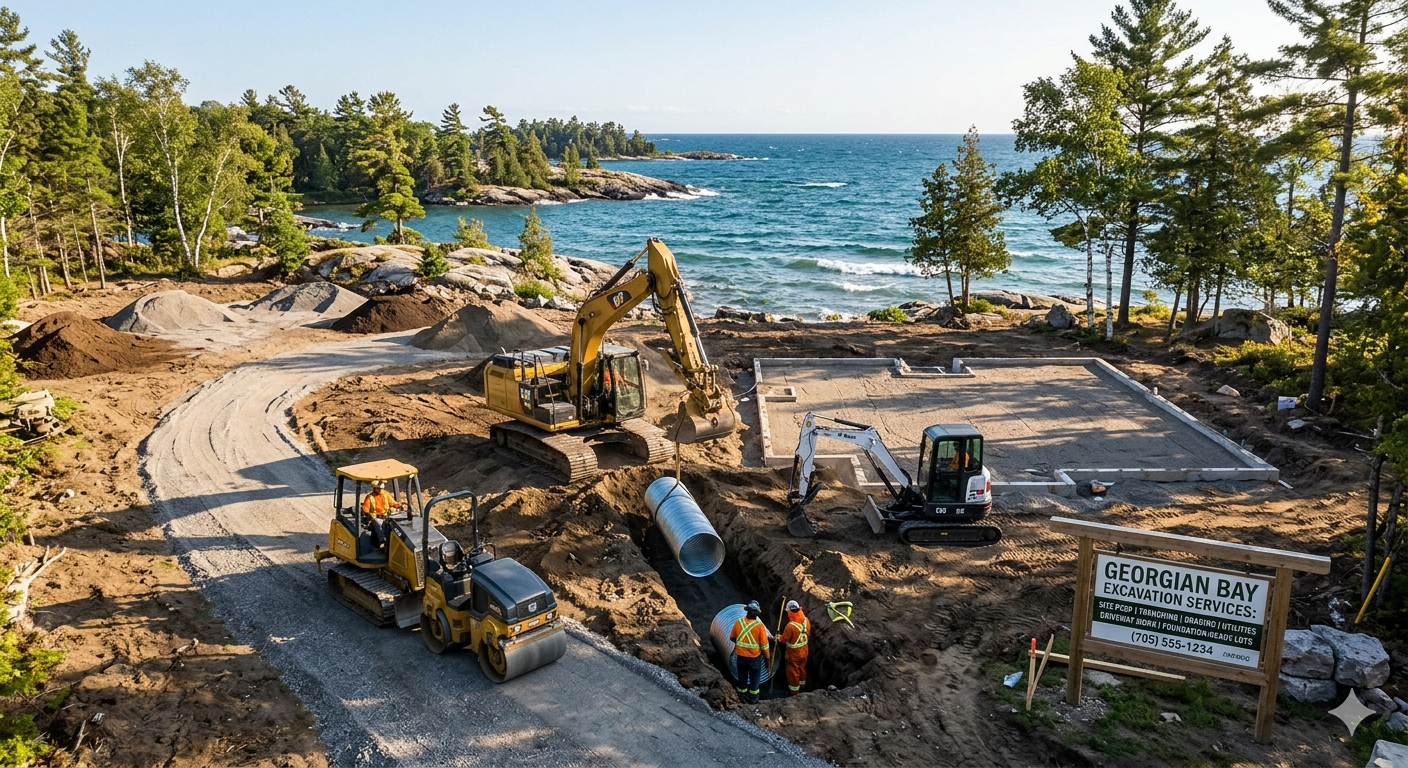
Excavation Services Georgian Bay: Site Prep, Trenching, Grading, and Real-World Ground Work
Most excavation mistakes are not dramatic on day one. They become dramatic later, when water does not drain, a driveway settles, a trench was put in the wrong place, or the foundation crew arrives and quietly wonders who prepared this lot and why they were so confident. This page is about avoiding that story.
If you are searching for excavation services Georgian Bay, there is a good chance you are not really shopping for digging. You are shopping for judgment. You want someone who can look at your land and tell you what needs to happen first, what can wait, what will cost more than you hoped, and what will go wrong if the site is rushed. That is the real job. Around Georgian Bay, the dirt is not just dirt. It can be sand, rock, roots, organics, wet ground, tight access, slope, and spring water with a personality disorder. The machine matters, sure. But the thinking matters more.
This is why excavation needs to be understood as an article topic, not just a sales page. Good site work connects directly to your septic layout, driveway life, drainage performance, utility routing, and whether the foundation area is truly ready for the next stage. A lot can look “pretty good” and still be nowhere near build-ready. It can even look beautiful right up until the first proper rain, which is when many sites reveal that they were graded with more optimism than skill.
So this page is going to teach the subject the way a property owner actually needs it explained. We are going to walk through what excavation services really include in Georgian Bay, why wet lots and rock change everything, how trenching and grading are tied together, and why the smartest time to involve a site contractor is usually earlier than most people do. If you are trying to prepare land the right way, this is where that starts.
Excavation is not one job. It is the first layer of every job that comes after it.
That is the mistake people make. They treat excavation as a stand-alone line item, as if the operator shows up, moves some earth, and then politely disappears without affecting anything else. Real life is ruder than that. Excavation decisions affect your build access, drainage, driveway base, septic layout, trench routing, and how smoothly the foundation stage goes.
That is why Georgian Bay Siteworks talks about excavation, grading, trenching, lot clearing, septic, and driveways as connected services, not isolated chores. The site itself demands that approach. :contentReference[oaicite:1]{index=1}
What excavation services in Georgian Bay actually include
Let’s start with the plain-English version. Excavation work usually begins long before there is a big hole in the ground. It often starts with getting the property into a condition where digging makes sense at all.
On real projects, excavation services commonly include:
- Site preparation for homes, cottages, garages, additions, and detached structures.
- Lot clearing where brush, trees, roots, stumps, and organics have to be removed first.
- Topsoil stripping and rough shaping so the site is workable and stable.
- Trenching for hydro, water, drainage, and underground services.
- Grading to direct water properly and support later stages of the build.
- Driveway and access-base preparation so people and material can actually get in and out without turning the site into pudding.
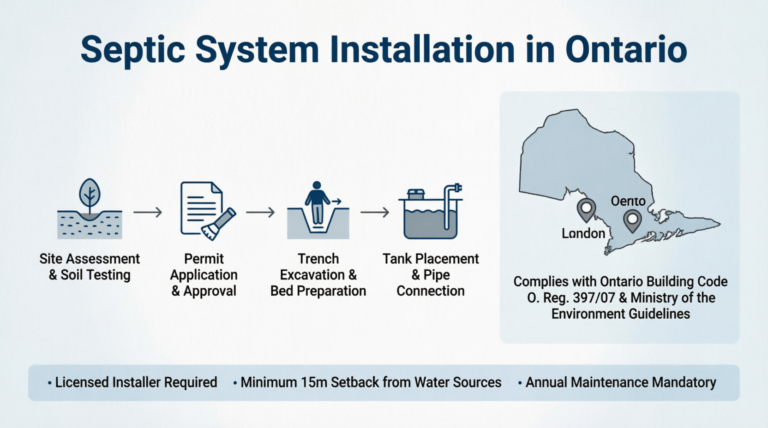
- Septic-related excavation tied to tank placement, bed areas, and line routing.
- Foundation-ready site work so the next crew is not inheriting a problem disguised as progress.
That list sounds simple until you stand on a raw lot and realize that every one of those steps affects the next one. If you clear the wrong area first, your access changes. If you trench without thinking about septic, you may dig twice. If you grade too soon or too casually, you can create drainage trouble that will follow the project like a bad smell.
Why Georgian Bay lots are not generic excavation jobs
Georgian Bay land has habits. Some of them are charming. Some of them cost money.
A site here may look easy from the road and still hide one or more of the usual suspects: wet areas, buried roots, soft soils, awkward access, rock, steep approach grades, or a combination of all of them just to keep everyone humble. This is where experience matters, because a contractor who knows the area knows that the site is not telling the whole truth during one dry week in June.
| Site Condition | Why It Matters | What It Can Change |
|---|---|---|
| Wet ground | Soft or seasonally wet areas can reduce stability and complicate access. | Sub-base requirements, drainage design, schedule, and equipment movement. |
| Rock | Rock affects digging speed, equipment needs, and price. | Trenching, foundation prep, driveway excavation, and timing. |
| Tight access | Trees, narrow entrances, slopes, or neighbouring structures limit how equipment can work. | Staging, clearing, delivery logistics, and labour efficiency. |
| Organics and roots | Hidden organic material under build areas causes trouble later. | Settlement, unstable support, driveway failures, and future repairs. |
This is exactly why site visits matter. Georgian Bay Siteworks says plainly that a site walk helps produce accurate pricing and avoid surprises, and that is not a throwaway line. It is the difference between quoting the property you actually have and quoting the one everyone wishes you had. :contentReference[oaicite:2]{index=2}
Trenching, grading, and drainage should be thought about as one conversation
This is one of the biggest teaching points on any excavation job: trenching and grading are not separate topics. They are roommates. Loud roommates.
If you trench for services without thinking about slope, future runoff, driveway alignment, or septic layout, you can create a site that looks organized for about three days and then starts arguing with itself. The path of underground services affects where you can shape the grade. The grade affects where water moves. The water affects driveways, foundations, and low spots. Pull one thread and the whole sweater starts unravelling.
That is why smart site work usually considers all of the following at once:
- Future building elevations and where water should move after the house is complete.
- Hydro, water, and drainage trench routes that do not conflict with septic or driveway plans.
- Positive drainage away from structures rather than vague promises to “fine tune it later.”
- Temporary and permanent site access that still works through wet weather and active construction.
- The relationship between driveway base, trench backfill, and long-term settlement.
If drainage is a major issue on your property, Grading and Drainage Georgian Bay should be part of the conversation early. It is a mistake to treat water like a finishing detail. Water gets involved whether invited or not.
How excavation connects to septic, driveways, and foundation work
This is where everything becomes practical.
Septic
On many rural and semi-rural properties, excavation and septic planning are basically cousins. Tank placement, bed area, setbacks, line routing, and driveway access all influence each other. If the site is shaped poorly or access is handled casually, the septic work can get harder and more expensive. For the local version of that discussion, Septic Systems Georgian Bay is a natural next read. For the broader homeowner overview, Septic Systems Ontario is useful as well.
Driveways and access roads
A driveway is not just something you see from the road. It is a structural working surface that has to survive freeze-thaw, heavy deliveries, runoff, and everyday use. If the base is weak, poorly crowned, or built over bad material, the driveway remembers. And it remembers publicly.
Foundations
Foundation crews need more than a hole. They need a site that is actually ready. That means proper access, sensible excavation, drainage awareness, stable working conditions, and enough thought given to the next stage that the job can keep moving instead of pausing for expensive problem-solving. If your project includes a basement or ICF foundation, ICF Foundation Contractor Ontario connects naturally with this stage. If the project is moving toward a full custom home, Build With Us is the obvious bigger-picture bridge.
When property owners should bring in an excavation contractor
Earlier than they usually do.
That is the honest answer. Many people wait until they think they are “ready to dig,” but by then the septic, driveway, trenching, and foundation decisions may already be drifting into each other. A better approach is to involve sitework thinking before the scope hardens into something expensive to change.
Bring in excavation planning early if:
- You are trying to choose the best building area on a raw lot.
- You need to understand access for trucks, concrete, or deliveries.
- You suspect water, rock, or slope may complicate the job.
- You are coordinating septic, trenches, driveway, and foundation work together.
- You want a quote that reflects the real site instead of a fantasy version of it.
Georgian Bay Siteworks also notes that it offers both fixed pricing for defined projects and hourly equipment rates for jobs where hidden conditions may change the scope. That is exactly the kind of practical distinction people should understand before the project starts. Some jobs are clear enough to fix-price. Others are honest enough to admit that the ground may still have a few surprises left to contribute. :contentReference[oaicite:3]{index=3}
Permits, code, and why the land does not care about your schedule
Another thing worth teaching clearly: excavation is not just a machine problem. It is often also a permit, approval, or coordination problem.
Depending on the lot and the scope, site work may touch septic approvals, utility locates, conservation issues, municipal requirements, drainage concerns, tree removal rules, and building-code-related site preparation. Georgian Bay Siteworks says directly that it handles permits, test holes, and conservation coordination, and that is important because site delays are often born from paperwork that was treated like a suggestion. :contentReference[oaicite:4]{index=4}
The official Ontario reference for the current code framework is the 2024 Ontario Building Code. You do not need to memorize it. You do need to respect the fact that site work often connects to rules outside the cab of the excavator.
Real-world ground work is really about teaching the land how the project is supposed to behave
If you came here looking for excavation services Georgian Bay, the most important thing to understand is this: excavation is not just digging a hole, cutting a trench, or pushing some material around. It is the process of setting the site up so the rest of the project can succeed. Good site work teaches water where to go, teaches traffic where to travel, teaches the foundation crew where they can work, and teaches the driveway how to survive after the job is done.
That is why this matters so much. A good excavation contractor is not just moving earth. They are reducing future problems. They are spotting the wet spot before it becomes the soggy disaster. They are dealing with roots before the driveway settles. They are shaping the site so the next trade is walking into a solution, not a mystery. Around Georgian Bay, that kind of judgment is worth more than horsepower alone. The machine digs. The thinking saves the job.
10 questions people ask about excavation services in Georgian Bay
1. What excavation services do you provide in Georgian Bay?
Typical excavation work includes site prep, trenching, grading, driveway base work, utility excavation, lot clearing, septic-related excavation, drainage shaping, and getting lots ready for foundations or other construction.
2. Can you prepare a lot before foundation work starts?
Yes. That can include clearing, stripping topsoil, shaping access, rough grading, drainage planning, trenching, and preparing the site so the next stage of the build is not slowed down by bad ground conditions.
3. Do you work on wet lots and difficult sites?
Yes. Wet ground, slope, soft soil, roots, tight access, and rock are all common site realities around Georgian Bay. Those conditions change how a site should be approached and priced.
4. Can you trench for hydro, water, and underground services?
Yes. Trenching is a common part of site prep, but it should be planned with drainage, septic, driveway, and building layout in mind so the work is not duplicated later.
5. How does excavation connect to septic and driveways?
They affect each other directly. Septic location, driveway access, trench routing, grading, and runoff all need to be thought about together if the site is going to work well after construction.
6. Do you handle rock excavation or poor access?
Yes. Rock and access issues are common in this region. They affect equipment choice, labour, timing, and cost, which is why site visits matter so much.
7. Can you help with lot clearing first?
Yes. Lot clearing is often the first real step before excavation can happen properly. Trees, stumps, roots, and organics need to be dealt with before a lot can truly be called build-ready.
8. When should I bring in an excavation contractor?
Usually earlier than most people do. It helps to involve sitework thinking before septic, trenching, driveway, and foundation decisions are all locked in separately.
9. Can you quote from plans alone?
Plans are helpful, but a site visit usually tells the fuller truth. Hidden stumps, slope, wet areas, access problems, and rock do not always show up nicely on paper.
10. Why does good excavation matter so much?
Because every shortcut taken in the ground shows up later somewhere else. Water, settlement, access trouble, driveway problems, septic complications, and delays all love bad excavation. Good site work prevents those headaches before they become permanent.
Ready to look at your site properly?
If you have a lot, a plan, a wet patch you do not trust, or a growing suspicion that the land is going to make some decisions for you, start there. A proper site conversation now is a lot cheaper than discovering the truth halfway through the job.