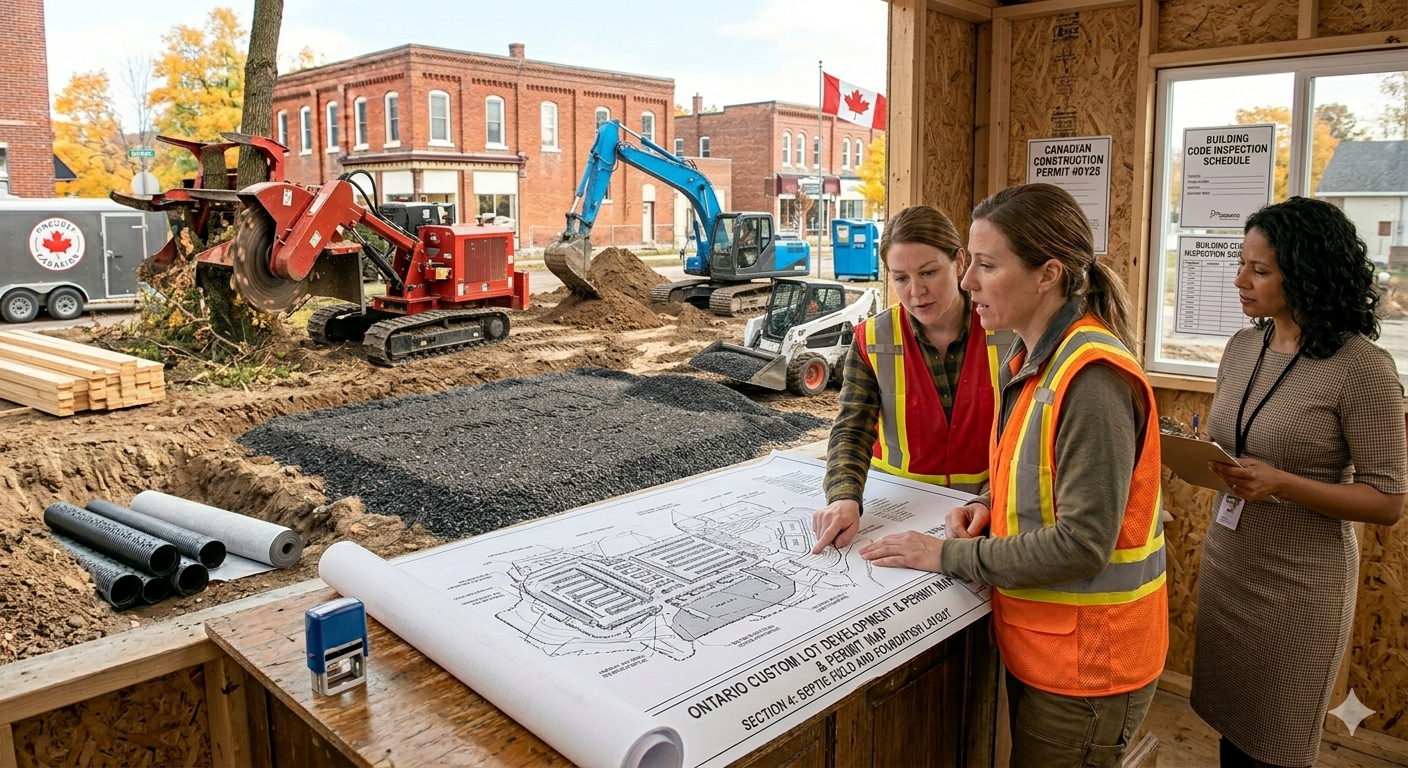
Land Preparation for a New Home Build in Georgian Bay: The Complete Site Sequence Before Construction Starts
Getting a rural Georgian Bay property from raw land to construction-ready involves more stages, more approvals, and more coordination than most first-time rural builders expect. Doing them in the right order saves money and avoids the delays that stall projects before a foundation is even poured. This guide covers the complete sequence — from the first permit application through to a graded, serviced site that is genuinely ready for a builder to start.
Building a new home on a raw rural lot in Georgian Bay or Simcoe County is a fundamentally different project from building on a serviced suburban lot. The land does not arrive cleared, graded, and connected to services. It arrives as trees, stumps, uneven ground, unknown soil conditions, and a set of regulatory requirements that need to be satisfied before a building permit can even be applied for. The site preparation phase — everything that happens between buying the land and breaking ground on the foundation — is where a rural build either starts well or starts badly.
Most of the budget surprises on rural builds in this region are not construction surprises. They are site surprises — perc test results that require a more expensive septic system, clearing costs that exceeded estimates because the lot condition was assessed from the road rather than on foot, NVCA approval timelines that pushed the construction start by two months, or stump removal costs that were not included in the original clearing quote. All of those surprises have one thing in common: they were predictable if the right questions had been asked at the right time.
This guide covers the complete land preparation sequence for a new home build in Georgian Bay in 2026 — what each stage involves, what order the stages need to happen in, what they cost, and where the common mistakes occur. It is the reference document we wish every rural property buyer had read before they made an offer on the land.
Stage one: survey, regulated area determination, and lot assessment
Before any professional is engaged, any permit is applied for, or any money is committed to design, the first stage of land preparation is understanding exactly what the property is and what can be done on it. That requires three things: a current survey, a regulated area determination from the NVCA, and a physical walk of the lot with someone who can read what they are looking at.
A current survey establishes the legal boundaries of the property, the location of any easements or rights of way, and the topography of the land. Many rural Georgian Bay properties were last surveyed decades ago, and the survey on file at the time of purchase may not be reliable enough to base a building location, setback calculation, or permit application on. Confirming the survey situation before design begins avoids setback errors that require redesign after a building permit application is already in.
The NVCA regulated area determination process, what it covers, and why it matters so much on Georgian Bay properties is explained in detail in the NVCA permit guide. Requesting the determination is the first action item on any Georgian Bay property where development is planned — before engaging an architect, before hiring a contractor, and before commissioning any design work that may need to be revised once the regulated area boundaries are known.
The physical lot walk — with a contractor or builder who knows the local terrain, soil conditions, and typical site challenges — rounds out the assessment stage. A site walk by someone experienced in Georgian Bay and Simcoe County site work identifies access challenges, soft ground areas, drainage patterns, potential septic bed locations, and the clearing scope more accurately than any aerial photograph or mapping exercise. It is time well spent before the project budget is set.
Stage two: permits and approvals — the longest lead time in the sequence
Permit applications are not paperwork that gets done after decisions are made. They are decisions that shape what can be done, and their timelines are the pacing constraint on the entire pre-construction sequence. On a regulated Georgian Bay property, getting permits started is the first action item — not something that happens once the contractor is booked and the clearing is scheduled.
The approvals that typically need to be in place before site work can begin on a new rural build in Georgian Bay include an NVCA permit for any regulated area activities, a septic permit from the local municipality, and potentially a building permit if the clearing or grading is tied to the building application. Each of those has its own application, its own review period, and its own conditions that affect how the site work gets done.
NVCA permit
Required for clearing, grading, septic installation, and construction within the regulated area. Review period: 30 days statutory, typically four to eight weeks in practice. Submit as early as possible — this is almost always the longest-lead approval in the sequence. Full details in the NVCA permit guide.
Septic permit
Required before septic installation. Needs a completed design based on perc test results. On regulated properties, NVCA approval must also be in hand before the municipal permit is issued. Submit concurrently with the NVCA application. Full details in the septic permit guide for Simcoe County.
Tree removal on regulated properties — which covers most clearing work on Georgian Bay lots near the shoreline or wetlands — requires an NVCA permit before a single tree comes down. The specific triggers, the process, and the seasonal restrictions that affect timing are covered in the tree removal permit guide for Tiny Township. The key practical point is that clearing cannot begin until the NVCA approval is in hand, which means the permit application needs to be submitted weeks or months before the contractor is scheduled.
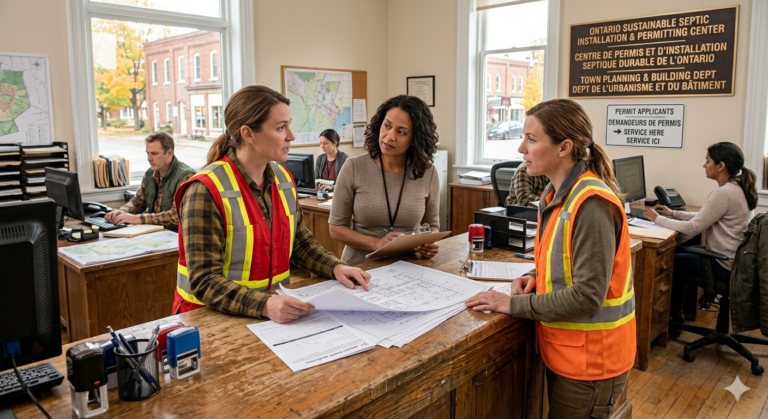
Georgian Bay Siteworks manages permit coordination — NVCA applications, municipal permit submissions, and regulated area determinations — as part of site preparation projects across Tiny Township, Tay, Midland, and the broader Georgian Bay region. The full scope of that service is covered on the permits and approvals page.
Stage three: lot clearing and stump removal
With permits in hand, physical site work begins with lot clearing — opening the land, removing trees and brush, and dealing with the stumps that are left behind. On most Georgian Bay properties this is the most visually dramatic stage of site preparation and also one where the scope is most commonly underestimated at the budgeting stage.
Clearing on a rural Georgian Bay lot involves more than felling trees and pushing brush. The density and size of the tree stand, the volume of material produced, the terrain and access conditions, and the conservation authority conditions attached to the permit all shape what the clearing actually involves and what it costs. A complete picture of what drives clearing cost on properties in this region is in the lot clearing cost guide — worth reading before any clearing quotes are accepted.
The full case for why stump removal matters so much in construction zones — and what happens to sites where it is skipped or done only to surface depth — is covered in detail in the stump removal guide. For properties where the question is surface grinding versus full excavated root removal, the stump grinding cost guide explains when each method is appropriate and what each costs in 2026.
On Georgian Bay properties with quality timber in the cleared stand, on-site milling is worth discussing with the clearing contractor. Usable logs milled into lumber on site eliminate hauling costs and leave the owner with a material they can use rather than a disposal bill. It is not the right fit for every project, but on properties with mature hardwood it changes the economics of the clearing phase significantly.
Stage four: site access and driveway construction
Construction equipment has to reach the building site before any foundation work can begin. On properties with no existing driveway — or with a driveway that cannot support excavators, concrete trucks, and delivery vehicles — establishing site access is a prerequisite for everything else. It is not a finishing detail that can wait until the build is underway. It is infrastructure that the build depends on from the first day equipment arrives.
On rural Georgian Bay properties, the driveway route often runs through ground that has just been cleared — which means it goes in after the clearing but before grading and foundation work. The base preparation for a construction driveway needs to be done properly even if the surface will be upgraded later, because a driveway that fails under the weight of a concrete truck or an excavator in mud season becomes a problem that costs more to fix mid-construction than to build correctly at the start.
What a construction driveway needs
Organics stripped from the corridor, stable granular sub-base compacted in lifts, properly sized culvert at the road entrance, and a surface course that supports heavy equipment through variable ground conditions including spring thaw.
What cuts corners cost
Gravel spread on unstripped organics or unprepared subgrade fails quickly under construction loads. A driveway rebuilt mid-project because it became impassable costs more — in time, money, and lost scheduling — than building it correctly before the first concrete truck arrives.
Long driveways on rural Georgian Bay lots — anything over 100 metres — involve terrain assessment, drainage planning, and sometimes multiple culverts that all need to be accounted for in the driveway budget before construction begins. The full picture of what rural driveway construction involves and what it costs in this region is in the gravel driveway cost guide. If a road entrance culvert is required — as it is on any property with a roadside ditch — that needs to be confirmed with the municipality and sized correctly. Undersized culverts flood, and flooded culverts damage driveway bases in ways that are expensive to repair.
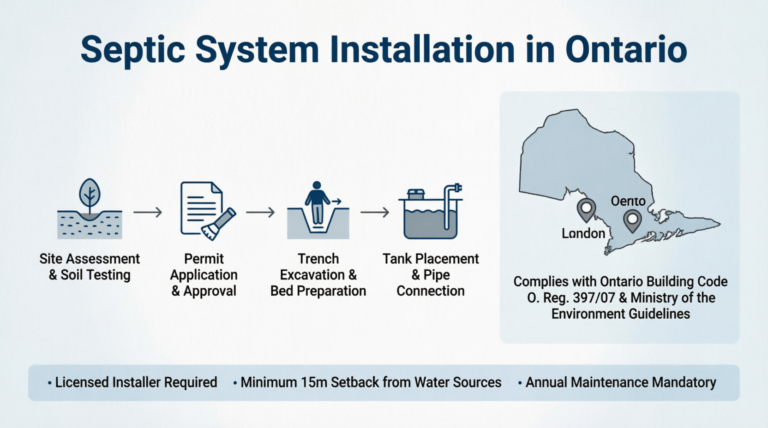
Stage five: perc test, septic design, and septic installation
On a rural property with no municipal sewer connection, the septic system is as fundamental to the build as the foundation. It has to be sited, designed, permitted, and installed in the right sequence — and that sequence has dependencies that affect the overall construction timeline significantly if they are not managed correctly from the start.
The perc test has to happen before the septic system can be designed, and the design has to be complete before the permit application can be submitted. On regulated properties the NVCA approval has to be in hand before the municipal septic permit is issued. And the septic system has to be installed and inspected before the final lot grading can be completed — because the drainage patterns around the septic bed are part of the grading plan. Running each of those steps in sequence rather than in parallel adds months to the pre-construction timeline that simply do not need to be there.
What a complete septic system installation actually costs in Georgian Bay and Simcoe County — including perc testing, design fees, permit fees, NVCA approval, excavation, and installation — is covered in the septic system cost guide. The range is genuinely wide depending on soil conditions and system type, and understanding it before committing to a build budget is one of the most important financial due-diligence steps on any rural property purchase.
The septic installation itself is part of the excavation scope on a new build — tank pit, distribution system trenching, bed area excavation, and backfill. Coordinating septic excavation with the broader site excavation phase, rather than scheduling it as a separate mobilization, is how sites stay on budget and on schedule through the groundwork phase.
Stage six: services — hydro, water, and communications
A new home in Georgian Bay needs power, water, and in most cases communications infrastructure run to the building site. Each of those services has its own utility provider, its own connection process, and its own lead time — and none of them happen automatically once the building permit is issued. They need to be applied for, designed, and scheduled as part of the overall site preparation sequence.
- Hydro service: a new electrical service connection to a rural property requires an application to Hydro One (or the local utility), an electrical service location determined by the utility, and trenching for the underground service run from the road to the building location. Utility trenching is usually done during the broader site excavation phase to avoid separate mobilization costs. Lead times for hydro connection in rural Simcoe County can run eight to sixteen weeks — this application should be submitted as early as the building location is confirmed.
- Water supply: on properties without access to municipal water, a drilled well is the water source. Well drilling needs to happen early enough that the well location and depth are known before foundation grading is finalized. Well casing and pump installation are separate from well drilling and need to be coordinated with the electrical connection. The well location also affects septic setback calculations — the required separation between the well and the septic system is a fixed minimum that constrains where each can go on the lot.
- Communications: internet and telephone services to rural properties in Georgian Bay vary significantly by location. Some areas have fibre runs that can be extended to new builds at reasonable cost. Others rely on satellite or fixed wireless options. Confirming what is available at the specific address before the build starts avoids discovering the limitation after the home is occupied.
Stage seven: grading, drainage, and final site preparation
With clearing done, access established, septic installed, and services roughed in, the final site preparation stage is grading — shaping the land so that water drains correctly away from the building location, the finished grades meet the building permit requirements, and the site is in the condition a foundation contractor needs to begin excavation.
Grading on a rural Georgian Bay property is not simply spreading topsoil and calling it level. It involves establishing drainage patterns that move water away from the building envelope, creating positive slope away from the foundation perimeter, managing stormwater in a way that does not discharge runoff onto neighbouring properties or into regulated features, and compacting any fill areas to the specification required under a building slab or foundation wall.
The relationship between grading, septic installation, and final lot preparation is close enough that it typically makes sense to coordinate all three as part of a single site work scope rather than as separately scheduled phases. The excavator doing the foundation excavation can also do the final grading. The crew that installed the septic system knows where the bed is, how the distribution runs, and where the grades need to be to protect the system. Keeping that knowledge in one coordinated scope rather than spreading it across multiple contractors reduces errors and re-work on the finished site.
What the full site preparation budget looks like in Georgian Bay in 2026
One of the most common budget problems on rural Georgian Bay builds is that the site preparation costs were either underestimated or not fully accounted for before the overall build budget was set. The result is a project that runs short of money before the foundation contractor has even arrived on site. Understanding what site preparation realistically costs — as a total, not as individual line items that are easy to minimize in isolation — is essential planning information for anyone buying rural land with a build in mind.
| Site preparation item | Typical range — Georgian Bay 2026 | What pushes it to the higher end |
|---|---|---|
| Survey update | $2,500 – $6,000 | Large lot, complex boundaries, significant time since last survey |
| Regulated area determination and permit fees (NVCA) | $400 – $1,500 | Complex site, shoreline property, multiple regulated features |
| Lot clearing and brush removal | $6,000 – $45,000+ | Tree density and size, lot area, debris disposal, conservation conditions — full detail in the lot clearing cost guide |
| Stump removal | $2,500 – $15,000+ | Number and size of stumps, full root removal required in build zones — full detail in the stump grinding cost guide |
| Driveway construction | $9,000 – $55,000+ | Lane length, terrain, ground conditions, culverts — full detail in the gravel driveway cost guide |
| Perc test, septic design, permit, and installation | $14,500 – $63,000+ | Soil conditions requiring engineered system, shoreline setbacks — full detail in the septic system cost guide |
| Well drilling and pump installation | $8,000 – $18,000 | Depth to water, rock drilling required, pump type and depth |
| Utility trenching (hydro, waterline, communications) | $3,000 – $12,000 | Distance from road to building location, number of services, rock in trench corridor |
| Grading, drainage, and final site preparation | $5,000 – $20,000 | Lot size, volume of fill required, complexity of drainage requirements |
| Total site preparation — typical Georgian Bay build | $70,000 – $200,000+ | Shoreline lots, heavily treed properties, engineered septic systems, and long driveways all push toward the higher end of this range |
These numbers represent site preparation costs only — before any building construction begins. On a rural Georgian Bay property, site costs of $80,000 to $130,000 are not unusual for a well-treed lot with a long lane, a regulated shoreline, and soil conditions that require an engineered septic system. Buyers who budget $30,000 for site prep on that kind of property are setting themselves up for a difficult conversation partway through the project.
The correct sequence — why order matters as much as scope
Every stage of land preparation has dependencies. Clearing cannot begin without permits. Septic cannot be installed without a design. Grading cannot be finalised without the septic location confirmed. Driveways are built after clearing but before heavy construction traffic arrives. Getting the sequence wrong does not just cause inconvenience — it causes re-work, damage to finished surfaces, and permit violations that halt the whole project.
| Stage | Must come before | Must come after |
|---|---|---|
| Survey and regulated area determination | All permit applications, all design work | Nothing — this is the first step |
| NVCA permit application | Clearing, grading, and any regulated area work | Regulated area determination |
| Perc test and septic design | Septic permit application, septic installation | Lot is accessible enough to test — may require some preliminary clearing first |
| Lot clearing and stump removal | Driveway construction, grading, foundation excavation | NVCA permit in hand |
| Driveway construction | Heavy construction equipment access, concrete trucks | Lot is cleared, culvert permit confirmed with municipality |
| Septic installation | Final lot grading, building occupancy | Septic permit issued, access established, installation area cleared |
| Utility trenching | Electrical connection, building occupancy | Service locations confirmed, trenching coordinated with site excavation |
| Final grading and drainage | Foundation excavation, topsoil and landscaping | Septic installed and inspected, all underground services in place |
Ready to take a raw Georgian Bay lot from trees to build-ready?
Georgian Bay Siteworks manages the full site preparation sequence — permits, clearing, stumping, driveways, septic coordination, utility trenching, and grading — as a coordinated package across Tiny Township, Tay, Midland, and the broader Georgian Bay region. One crew, one schedule, no gaps between trades.
Frequently Asked Questions
How long does land preparation take before a new home build in Georgian Bay?
On a typical rural Georgian Bay property — treed lot, regulated area, septic required — the site preparation sequence from starting permits to a graded, serviced, construction-ready site takes six to twelve months when managed efficiently. The NVCA and septic permit processes are the longest-lead items, typically running four to eight weeks each when submitted concurrently. Properties that start the permit process the fall before a planned spring construction start are in the best position to hit their build schedule. Properties that start in spring rarely break ground before midsummer at the earliest.
What is the most common budget mistake on rural Georgian Bay builds?
Underestimating site preparation costs — either by using provincial averages that do not reflect local conditions, by omitting items like stump removal and NVCA compliance costs, or by treating site prep as a residual after the construction budget is set rather than as a primary line item that gets sized first. On a heavily treed Georgian Bay lot with a long lane, a regulated shoreline, and an engineered septic requirement, site preparation costs of $100,000 to $150,000 are realistic. Budgeting $30,000 for that scope and expecting the difference to be covered by construction contingency is how builds run out of money before framing starts.
What comes first — clearing the lot or getting the permits?
Permits always come first. On any regulated Georgian Bay property, tree removal and site clearing require an NVCA permit before work begins. Clearing without that permit is a violation of the Conservation Authorities Act that can result in a stop-work order, a restoration order requiring replanting at the owner’s cost, and fines. The permit application needs to be submitted weeks before clearing is scheduled — not after the contractor is already booked and equipment is ready to move.
Can the driveway be built at the same time as the lot is being cleared?
Yes, and on most projects it should be — the clearing crew opens the corridor, and the driveway base preparation follows immediately while equipment is still on site. The clearing removes the vegetation, the stumping removes root systems from the driveway corridor, and the base preparation and gravel work follows in sequence. Doing all three as a coordinated scope is more efficient and less expensive than scheduling them separately. What should not happen is building the driveway surface before the driveway corridor is properly cleared and stumped — organic material under a driveway base causes failure regardless of how good the gravel is on top.
Do I need a separate NVCA permit for every stage of site preparation?
Not necessarily — a single NVCA permit can cover multiple activities on a regulated property if the application describes the full scope of regulated work being proposed. On a new home build where clearing, grading, driveway construction, and septic installation are all happening in regulated areas, it is often more efficient to submit one comprehensive permit application covering the full site preparation scope than to submit separate applications for each activity. The NVCA can advise on the most efficient approach during pre-consultation, which is one of the reasons pre-consultation is worth doing before any application is submitted.
How much should I budget for site preparation on a rural Georgian Bay lot?
On a typical new home build on a treed rural lot in Georgian Bay or Simcoe County in 2026, total site preparation costs — clearing, stumping, driveway, septic, well, utilities, and grading — commonly range from $70,000 to $150,000 before any building construction begins. Shoreline lots, heavily treed properties, engineered septic requirements, and long driveway lanes all push toward the higher end of that range. The site preparation cost guides on this site — covering lot clearing, stump removal, driveways, and septic system costs individually — provide the detail needed to build an accurate budget for each component before committing to a project.
Should the perc test happen before or after clearing?
Before clearing is ideal if the lot is accessible enough to reach the proposed septic area with test equipment. Getting perc results before clearing is complete means the septic design — and therefore the septic permit — can be in progress while clearing is still happening, rather than waiting for clearing to finish before starting the test. On heavily treed lots where the proposed septic area is inaccessible, enough preliminary clearing to allow test equipment access may need to happen first. Confirming this with the septic designer during initial consultation helps sequence the work correctly.
What is the difference between site preparation and construction?
Site preparation is everything that happens to prepare the land before a foundation contractor begins building. It includes permits, clearing, stumping, driveway construction, septic and well installation, utility trenching, and final grading. Construction begins when a foundation contractor starts excavating for the foundation. The two phases are distinct and involve different trades, different permits, and different budget categories — though they are managed as a continuous sequence on a well-run project. Site preparation is complete when the lot is cleared, serviced, graded, and accessible in the condition the foundation contractor needs to start work.
Can Georgian Bay Siteworks manage the full site preparation sequence?
Yes. Georgian Bay Siteworks handles the complete site preparation sequence for new home builds across Tiny Township, Tay, Midland, Penetanguishene, Wasaga Beach, Collingwood, and the broader Georgian Bay region — including NVCA permit coordination, lot clearing and stump removal, driveway construction, septic installation coordination, utility trenching, and final grading. Managing all of those phases as a single coordinated project rather than as separately contracted scopes is how sites get from raw land to construction-ready on schedule and without the gaps between trades that cause delays and re-work.
What if the property is being built by icfhome.ca — do they handle site preparation too?
Yes. For complete custom home builds in the Georgian Bay and Simcoe County area, the team at icfhome.ca manages site preparation, NVCA and building permits, and construction as a fully integrated project. The site preparation sequence — permits, clearing, septic, driveway, and grading — is handled by the same team that builds the home, which means the site is prepared to the exact specification the build requires and the transition from site work to construction happens on a single coordinated schedule.