Septic System Cost in Ontario: What Georgian Bay and Simcoe County Property Owners Actually Pay
A new septic system is one of the largest single costs on a rural property build — and one of the hardest to estimate without a site visit. The range in Ontario is genuinely wide, and the variables that move the number are not always obvious. This page explains what drives septic system cost so you can budget properly before anyone breaks ground.
The most common number people find when searching for septic system cost in Ontario is somewhere between $10,000 and $25,000. That range is real, but it is also wide enough to be nearly useless for budgeting a specific property. A conventional gravity-fed bed on sandy loam soil with easy excavation access is a very different job from an engineered raised bed system required on a clay-heavy lot with a high water table and a conservation authority setback to manage.
In Georgian Bay and Simcoe County, the properties that need septic systems tend to be rural, often treed, frequently near water, and sometimes on soil that does not cooperate with the cheapest installation option. Those conditions matter. They are why the actual cost on a local property often sits at the higher end of provincial ranges — or beyond them entirely when site conditions require a more complex engineered solution.
Understanding what you are actually paying for, and why certain conditions push the number up, puts you in a better position when you are reviewing quotes, talking to a designer, or trying to figure out whether a particular lot is a reasonable purchase for the project you have in mind.
The full cost of a septic system — not just the tank and bed
When people ask about septic system cost, they usually picture the physical installation — the tank going in the ground and the leaching bed spreading out across the yard. That is a real part of the cost. It is not the whole picture. A complete septic installation in Ontario includes several stages that each carry their own price tag, and the total of all of them is what the project actually costs.
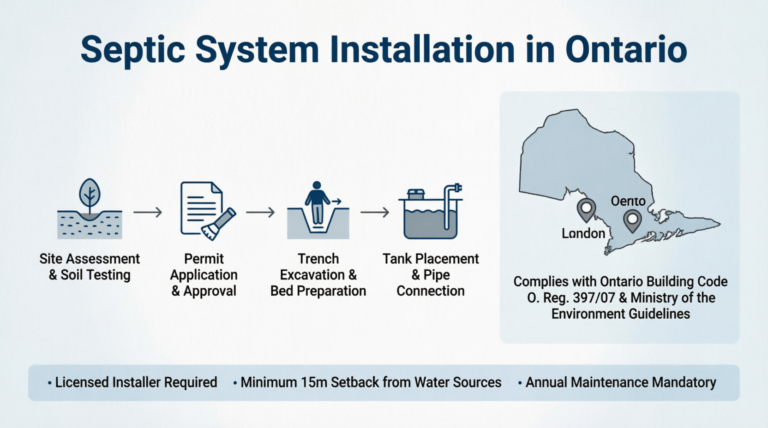
The full cost includes a site evaluation and percolation test, a system design by a qualified designer, permit application fees to the municipality, excavation of the tank pit and bed area, supply and installation of the tank, distribution system, and leaching bed material, inspection coordination, and final grading and restoration of the disturbed area. Each of those stages is real work by real people, and each one gets priced. A quote that only covers installation without the surrounding scope is not a complete project budget.
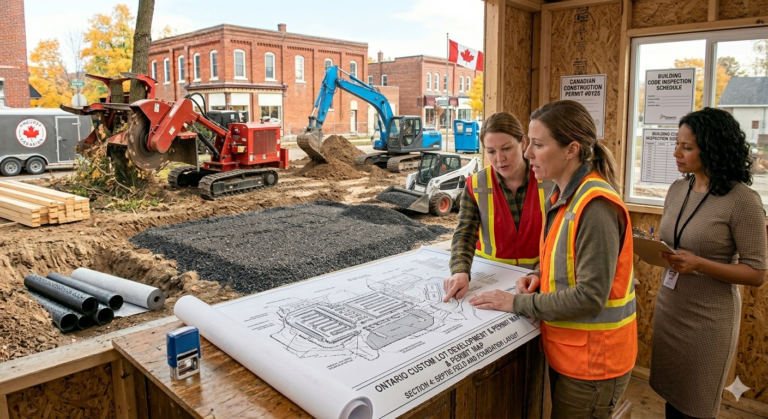
For properties that are also undergoing lot clearing or broader site preparation ahead of a build, the septic work typically fits into a larger sequence. Understanding how it connects to the full site prep process is worth doing early — the site preparation page covers how the stages typically relate to each other.
Septic system cost ranges in Ontario for 2025
These are realistic ranges for septic installation in rural Ontario based on system type and site conditions. They include design, permits, excavation, materials, and installation. They do not include lot clearing, driveway access construction, or well installation if those are also needed. Every site is different — a walk of the property is the only way to get an accurate number.
| System type | Best suited for | Typical cost range (2025) | What pushes it higher |
|---|---|---|---|
| Conventional gravity bed | Good-draining sandy or loamy soils, adequate lot size and setbacks | $12,000 – $22,000 | Deep excavation, difficult access, large household size requiring bigger bed |
| Pressure distribution system | Soils that drain slowly or require more even effluent distribution | $18,000 – $30,000 | Pump chamber additions, electrical connections, pump maintenance requirements |
| Raised bed system | High water table, shallow soil depth, or rocky ground limiting conventional installation | $22,000 – $38,000 | Volume of imported fill required, site grading, engineered design complexity |
| Alternative or engineered system | Difficult soils, small lots, shoreline properties with strict setbacks | $30,000 – $55,000+ | System type, ongoing maintenance contract requirements, conservation approvals |
Shoreline and waterfront properties in Georgian Bay often end up in the alternative or engineered system category because of the setback rules that apply near water. The Nottawasaga Valley Conservation Authority and local municipalities impose minimum distances between septic systems and water bodies, wells, and property lines that can eliminate the simpler installation options on many rural lots.
Why the perc test is the most important number you will get
Before any system is designed and before any permit is applied for, the soil on the property has to be evaluated. The percolation test — usually called a perc test — measures how quickly water moves through the soil at the depth where the leaching bed will sit. That number determines what type of system is permitted on the lot. It is not a recommendation. It is a constraint that the design must work within.
Good perc results
Sandy or loamy soils that drain well open up the simpler, less expensive conventional system options. The design is more straightforward and costs less to engineer and install.
Poor perc results
Clay-heavy, compacted, or high-water-table soils restrict what is permitted. The system has to compensate for what the soil cannot do naturally — and that always costs more.
Simcoe County has a wide range of soil types. Some areas — particularly sandier lots toward Georgian Bay’s shoreline — perc very well. Others, especially areas with clay subsoils further inland, can produce results that require an engineered solution. You cannot know which category your lot falls into without doing the test. Anyone quoting a septic system on a property where a perc test has not been done is guessing at the most important input in the entire design.
Design and permit fees — the costs people forget to budget
A septic system in Ontario cannot be installed without a permit, and a permit cannot be issued without an approved design. Those two requirements mean that design fees and permit costs are not optional extras. They are fixed entry costs that come before a single machine moves on site.
Septic design in Ontario must be completed by a qualified designer or engineer, depending on system complexity. Design fees typically range from $1,500 to $4,500 for a straightforward residential system. More complex engineered systems can push design costs higher. Municipal permit fees vary by municipality and system size — in Simcoe County expect roughly $500 to $1,500 for the permit application itself. Those numbers are on top of the installation cost, not included in it.
Georgian Bay Siteworks manages permit applications and coordinates with qualified septic designers as part of the installation process. For a broader look at what the approvals process typically involves in this area — including conservation authority requirements that often run alongside septic permits — the permits and approvals page covers the full picture. The Ontario Building Code also sets out the provincial requirements that all septic systems must meet regardless of local rules.
Excavation — the line item that surprises people the most
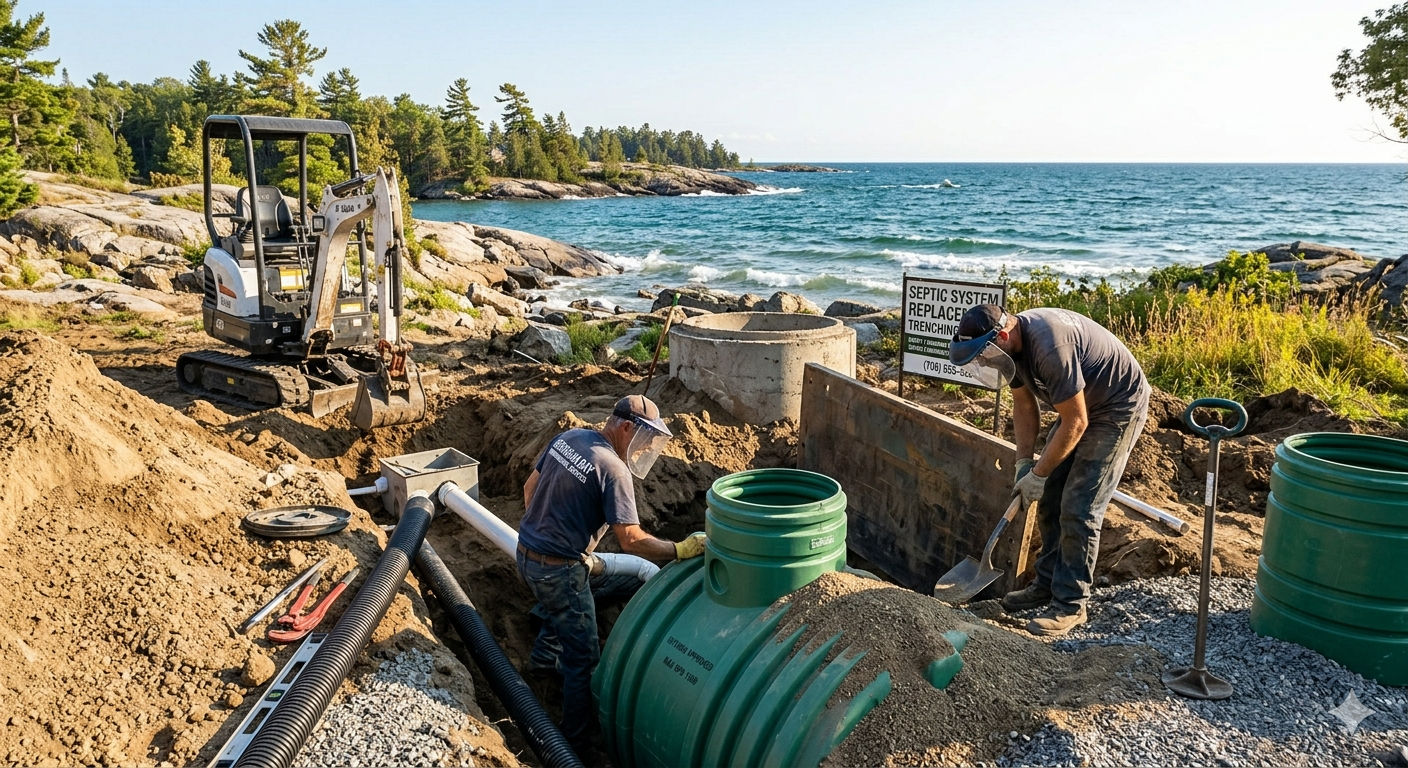
Septic installation is not just a plumbing job. It is a significant excavation project. The tank pit, the distribution system trench, and the leaching bed area all require machine time. On a straightforward site with good access and cooperative soil, that excavation is manageable and the cost is predictable. On a difficult site, excavation can become the dominant cost in the entire project.
Rock is the worst-case scenario. If bedrock or large boulders sit close to surface in the leaching bed area, blasting or mechanical breaking may be required before the system can go in at all. That is a significant and often unexpected cost for property owners who did not know what was under the ground. Test holes drilled during the site evaluation phase are supposed to reveal those conditions early — which is one more reason the evaluation stage matters so much.
The excavation scope for a septic system also connects directly to the broader site work that typically surrounds it. If excavation services are already on site for a foundation or land clearing, coordinating septic excavation at the same time usually reduces total equipment hours and cost compared to mobilizing separately for each phase.
Setbacks, conservation rules, and why location on the lot matters
A septic system cannot go just anywhere on a property. Ontario’s Building Code sets minimum distances between a septic system and water sources, wells, property lines, structures, and water bodies. On a large rural lot with no nearby water or neighbours, those setbacks are usually manageable. On a waterfront property, a smaller lot, or one with multiple constraints layered on top of each other, the setbacks can severely limit where the system can physically be placed — and sometimes eliminate certain system types altogether.
Standard residential setbacks
Typical minimums include 15 metres from a water supply well, 15 metres from a water body, 1.5 metres from a property line, and 1.8 metres from a building. These vary by system type and municipality.
Conservation authority overlays
On regulated properties near Georgian Bay shorelines, wetlands, or floodplains, the NVCA may impose additional setbacks or require an approval before any below-grade work begins. These rules run alongside the building permit process, not instead of it.
Setback constraints are one of the main reasons waterfront and near-water properties in Georgian Bay tend to pay more for septic systems than inland properties do. When the available installation area is constrained by setbacks, the system has to be engineered to fit what the lot allows rather than simply designed for what is cheapest. That engineering costs money, and the systems it produces cost more to install and sometimes more to maintain.
Septic system replacement versus new installation — the cost is not the same
Replacing a failed or aging septic system on an existing property is a different project from installing a new system on a raw lot. Sometimes it is cheaper because the infrastructure already exists and the lot layout is known. More often on older Georgian Bay properties it is more complicated — because the system being replaced was installed under older rules, the replacement has to meet current code, and the lot that made sense for a system thirty years ago may not have the available space and setbacks required today.
Failed systems also tend to require more excavation to remove the old tank and distribution system before the new installation can begin. That demolition and removal scope adds time, equipment hours, and disposal costs that do not exist on a fresh installation. Before buying a rural property with a system of unknown age or condition, a septic inspection is one of the most valuable due-diligence steps you can take. The cost of that inspection is small compared to the cost of discovering a full replacement is needed after closing.
How septic cost fits into the total rural property build budget
For people building a new home on a rural Georgian Bay or Simcoe County property, septic is one of several significant site costs that arrive before the house itself is started. Lot clearing, driveway construction, well installation, hydro service, and septic are all costs that get paid before a foundation is poured. Together they can add $80,000 to $150,000 or more to a rural build budget, depending on the property and the services required.
Septic is rarely the largest of those costs, but it is often the one with the most variability — because soil conditions, system type, and setback constraints are genuinely unknown until the site is evaluated. That uncertainty is worth factoring into how much contingency you carry in the early stages of a rural build budget. A project that plans for a conventional system and discovers it needs an engineered alternative will feel that difference in the budget before framing begins.
For a fuller picture of where septic fits inside the total cost of building in Ontario, the cost to build a house in Ontario is a useful reference that covers how site costs and construction costs relate to each other across the full project.
Questions to ask before accepting a septic installation quote
A septic quote that looks straightforward on paper can cover very different scopes depending on what the contractor has and has not included. Before you accept any price, make sure you have clear answers to each of these:
- Does this quote include the perc test and site evaluation, or is that a separate cost?
- Is the system design fee included, or billed separately by the designer?
- Are municipal permit fees included in the total?
- What system type is this quote based on — and what happens to the price if the perc test requires a different system?
- Does excavation include rock or difficult ground conditions, or is that a contingency item?
- Is final grading and site restoration after installation included?
- Who coordinates the inspection — the contractor or the homeowner?
Those questions will not always produce comfortable answers, but they will tell you whether the quote you are holding covers the real project or just the easy part of it. A contractor who cannot answer them clearly is probably not pricing the full scope.
Common septic planning mistakes that cost property owners money
| Mistake | What happens next | Why it costs more |
|---|---|---|
| Skipping the perc test before budgeting | Budget is built around a conventional system the soil does not permit. | Redesign, re-permit, and the cost of an engineered system arrives as a surprise mid-project. |
| Not budgeting design and permit fees separately | Pre-permit costs arrive before installation and were not in the budget. | Cash flow problems at the start of the project before a machine has moved. |
| Buying a waterfront property without a septic inspection | A failing or non-compliant system requires full replacement to current code. | Full replacement on a constrained waterfront lot is one of the most expensive septic scenarios that exists. |
| Scheduling septic separately from other site excavation | Equipment mobilizes multiple times for work that could have been done together. | Multiple mobilization costs instead of one coordinated site work phase. |
| Ignoring conservation authority requirements near water | Work gets stopped pending approvals that should have been in place before digging. | Delays, possible fines, and re-engineering if the system placement does not meet regulated setbacks. |
Need an accurate septic cost for your specific property?
Online ranges only go so far. The soil conditions, lot layout, and setback constraints on your property are what determine the real cost — and the only way to know those is a site visit. We coordinate the full process: site evaluation, design, permits, excavation, and installation.
Frequently Asked Questions
How much does a septic system cost in Ontario in 2025?
A complete septic system installation in Ontario in 2025 typically ranges from $12,000 to $55,000 or more, depending on system type, soil conditions, excavation difficulty, and whether conservation authority approvals are required. Conventional gravity systems on good soils at the lower end, engineered systems on difficult or constrained lots at the higher end. Design fees, permits, and excavation are included in those ranges — they are not extras.
What is a perc test and do I need one?
A percolation test measures how quickly water drains through the soil on your property at the depth where the leaching bed will be installed. It is required before a septic system can be designed or permitted in Ontario. The results determine what system type is allowed on your lot — which is the single biggest driver of overall installation cost.
Are design fees and permit costs included in septic quotes?
Not always, and this is one of the most common reasons quotes look different from each other. Always ask explicitly whether the design fee, perc test, and permit application costs are included. A quote that only covers physical installation can look significantly cheaper while covering far less of the total project.
How much does it cost to replace an existing septic system in Ontario?
Replacement costs are highly variable and often higher than new installations on comparable lots, because the replacement must meet current code regardless of when the original was installed. On waterfront or constrained rural properties where setbacks have changed, replacement can range from $25,000 to well over $60,000 for a full engineered system. A septic inspection before buying any rural property is strongly recommended.
Do I need conservation authority approval for a septic system near Georgian Bay?
On many properties near Georgian Bay, wetlands, or other regulated water features, yes. The Nottawasaga Valley Conservation Authority regulates work near shorelines and watercourses, and a septic installation in or near those regulated areas may require an NVCA permit in addition to the municipal building permit. These approvals need to be in place before excavation begins.
Why does a waterfront septic system cost so much more?
Because the setbacks required near water often eliminate conventional system options and push the design toward engineered alternatives. A raised bed, pressure distribution, or alternative system required by setback and soil constraints on a waterfront lot costs significantly more to design, permit, and install than a conventional gravity bed on an inland property with cooperative soil conditions.
How long does it take to get a septic permit in Ontario?
Timelines vary by municipality and the completeness of the application. A straightforward residential application in Simcoe County typically takes four to ten weeks. Applications that require conservation authority approval alongside the municipal permit can take longer. Building a septic permit timeline into the overall project schedule from the beginning prevents the delays that come from treating it as a last-minute step.
Can a septic system be installed in winter in Ontario?
Sometimes, on ground that is not frozen too deeply and where excavation can proceed normally. In practice, most septic installations in the Georgian Bay region happen between late April and November. Frozen ground, spring melt conditions, and access limitations all affect when equipment can safely work. If a project has a spring or summer build start, the septic permitting process should begin well before winter to avoid waiting for permits while the build is ready to proceed.
Should I coordinate septic installation with my lot clearing and excavation?
Yes, almost always. If clearing and excavation are already happening on the property, coordinating the septic excavation at the same time reduces mobilization costs, avoids disrupting finished areas, and keeps the site sequence logical. The septic permit needs to be in hand before that excavation begins, so the design and permit process should start early enough to be ready when the equipment is on site.
What is the difference between a conventional and an engineered septic system?
A conventional system uses gravity to distribute effluent through a leaching bed in soil that drains well enough to handle it naturally. An engineered system — which includes raised beds, pressure distribution, and alternative treatment systems — is required when the soil cannot support a conventional approach due to poor drainage, high water table, shallow depth to bedrock, or constrained lot conditions. Engineered systems cost more to design, install, and in some cases maintain, but they are not optional when soil conditions or regulations require them.