Lot Clearing Cost in Georgian Bay and Simcoe County: What Actually Drives the Price
Lot clearing is one of the hardest services to price online because the range is genuinely wide. A lightly brushed acre and a heavily treed lot with stumps, slopes, and a conservation setback are both called “lot clearing” — but they are very different jobs. This page explains what actually moves the number so you know what to expect before you call anyone for a quote.
Most people start their search for lot clearing cost online and come away more confused than when they started. That is because the numbers posted elsewhere are usually pulled from national averages that have little to do with a treed rural property in Georgian Bay, Simcoe County, or Muskoka. A half-acre suburban lot in Mississauga and a wooded waterfront parcel in Tiny Township are both described as “lots to clear,” but the jobs are nothing alike.
The price of clearing a lot in Ontario in 2025 can range from a few thousand dollars for light brush removal on an accessible property to well over thirty thousand dollars for dense, heavily treed land with stumps, difficult terrain, and conservation approvals required before a single tree comes down. That is not a vague range. It reflects how genuinely different these jobs are from each other.
Understanding what drives the cost does not just help you budget. It helps you ask better questions when you get a quote, understand why two contractors come back with very different numbers, and make sure the work scope matches what the site actually needs — not just what looks cleared from the road.
The real factors that move the price up or down
Lot clearing is not priced by the acre in any straightforward way. The acreage matters, but it is one of the least reliable predictors of cost on its own. What contractors actually price is time, equipment, and disposal — and all three are shaped by the condition of the lot, not just its size.
Tree size is one of the biggest variables. Clearing brush and small saplings is fast, low-risk work that moves quickly with the right equipment. Removing mature hardwood or softwood trees — the kind that cover a lot of Georgian Bay properties — is slower, requires more careful planning around fall direction and equipment placement, and produces a much larger volume of material that has to go somewhere. A lot full of forty-year-old maples costs far more to clear than one covered in young poplar and scrub brush of the same total area.
Slope, access, and soil conditions affect how equipment can move and how safely the work gets done. A flat, accessible lot lets machines work efficiently. A sloped property with soft spring ground, a long lane, or no cleared access route at all adds time and cost at every stage. That is not padding — it is the real mechanics of how site work gets priced in the field.
Rough price ranges by lot condition in 2025
These are ballpark ranges for lot clearing in the Georgian Bay and Simcoe County area based on typical project conditions. They are starting points for budgeting conversations, not fixed quotes. Every property is different, and the only accurate number for your lot comes from someone who has walked it.
| Lot condition | Typical scope | Rough range (2025) | What pushes it higher |
|---|---|---|---|
| Brush and scrub only | Low vegetation, small stems, no significant trees or stumps | $2,500 – $6,000 | Poor access, large area, wet ground conditions |
| Lightly treed | Scattered small-to-medium trees, minimal stumping required | $6,000 – $14,000 | Stump removal scope, debris hauling distance, slope |
| Heavily treed | Dense mixed bush, mature trees, full stump removal needed | $14,000 – $28,000 | Tree size, root systems, volume of material, conservation approvals |
| Dense mature forest with difficult access | Large trees, rough terrain, long driveway access needed first | $25,000 – $45,000+ | Conservation permits, remote location, soft or wet ground, steep grade |
These numbers assume tree felling, brush processing, and basic site opening. Stump removal, driveway construction, grading, and material hauling are often quoted separately. On a larger or more complex property, those additions can be as significant as the initial clearing cost itself.
What a clearing quote usually includes — and what it usually does not
One of the most common reasons people are surprised by clearing costs is that they are comparing quotes that do not cover the same scope. One contractor includes stump grinding. Another prices only felling and pushing. A third includes hauling. A fourth leaves the brush in piles on site. When you compare those four numbers, you are not comparing the same job.
Usually included in a clearing quote
Tree felling, limbing, and bucking. Brush chipping or piling. Basic site opening to make the area accessible for the next stage of work.
Often priced separately
Stump grinding or full root removal. Debris hauling off site. Topsoil stripping. Grading. Driveway access construction. Conservation authority permit coordination.
Before accepting any quote, ask explicitly what happens to the material. Does brush get chipped and spread on site, or hauled away? Are stumps ground or left? Is root removal included? What is the finished state of the site — cleared but rough, or ready for the next stage of work? Those questions reveal whether two quotes are actually comparable or just sharing a label.
If the lot is being cleared ahead of a build, it is worth connecting this conversation to the broader site preparation process. Clearing and site prep are often treated as separate phases, but planning them together usually saves money and avoids doing the same ground twice.
Stump removal: the cost factor most people underestimate
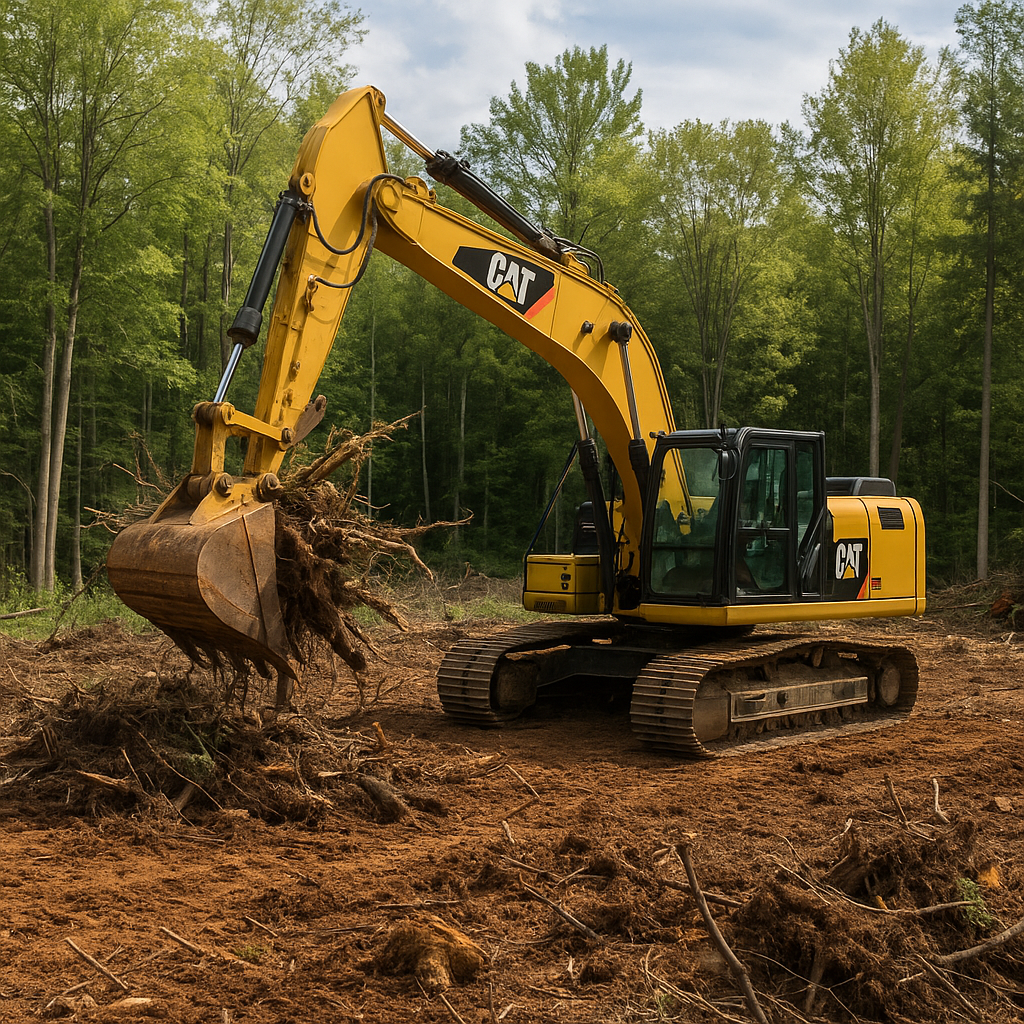
On a treed lot, stumps are almost always the most underestimated part of the budget. The tree comes down and the clearing looks done. Then someone starts pricing the stumps and the number moves significantly. On a heavily treed lot, stump removal can cost nearly as much as the clearing that came before it — sometimes more.
The price depends on stump size, root mass, depth, and what the area will be used for. A stump at the edge of a yard that will become lawn is a different job from a stump sitting in the middle of a future building pad or driveway corridor. The latter needs complete root removal and ground restoration so the site actually performs the way it should. That takes more time and costs more. Cutting it flush and burying the roots is not a solution — it is a problem deferred to whoever builds on top of it next.
For a deeper look at why this matters for the overall site, the stump removal page covers the specific scenarios where buried organics cause the most trouble later. It is worth reading before finalizing a clearing scope.
Access and terrain — the hidden cost driver on rural properties
Equipment has to get to the trees before it can take them down. On a lot with road frontage and open access, that is simple. On a rural Georgian Bay property with a long lane, soft ground, a slope, or no existing access at all, getting equipment on site is part of the job cost — and sometimes a significant part.
Spring and early summer are particularly tricky in Simcoe County. The ground is wet, frost is coming out, and soft conditions can limit when and where heavy equipment moves without causing ruts or damage. Contractors who work in this region know how to read those conditions and sequence the work accordingly. Anyone who does not factor terrain and season into a Georgian Bay quote is probably not pricing the real job.
Terrain also affects the driveway construction that typically follows clearing. If the access route is rough or poorly graded after clearing, the driveway build costs more. Thinking about the two together from the start usually produces a better result at a better overall price.
Conservation authority approvals and what they add to the budget
Many Georgian Bay and Simcoe County properties fall within the jurisdiction of the Nottawasaga Valley Conservation Authority (NVCA) or other local conservation bodies. On those properties, clearing trees — especially near water, wetlands, or regulated setback areas — requires an approval before work begins. Skipping that step is not a shortcut. It is a bylaw violation that can result in stop-work orders, fines, and forced remediation.
The cost of the approval itself is usually manageable — permit fees vary by municipality and project scope. The more significant cost is time. Conservation authority approvals can take four to twelve weeks depending on the project, the time of year, and how complete the application is. If clearing needs to happen before a build start, that timeline has to be built into the project schedule from the beginning, not discovered as a surprise after the contractor is booked.
Georgian Bay Siteworks coordinates NVCA and municipal permit applications as part of the clearing process. For more on what is regulated and what typically requires approval, the permits and approvals page covers the specifics for the area. The Nottawasaga Valley Conservation Authority also publishes current permit requirements on their website.
What happens to the material — and why it matters for your budget
Everything that gets cleared has to go somewhere. How it goes, and where, is one of the more flexible cost variables in a clearing project — and one where decisions made early can save real money.
Chip and spread on site
Brush and limbs get run through a chipper and spread across the property as mulch. Keeps costs lower since nothing leaves the site. Works well in areas that will become naturalized or wooded yard.
Haul away
All material is trucked off site to a disposal facility. Clean result but adds hauling and tipping fees. Sometimes the only option when site conditions or conservation rules limit on-site spreading.
On many Georgian Bay properties, there is a third option worth discussing: on-site milling. If cleared trees include usable hardwood or softwood, Georgian Bay Siteworks can mill that material into lumber directly on the property. That eliminates hauling costs, and the client ends up with finished lumber instead of a disposal bill. It is not the right fit for every project, but on properties with quality timber it changes the economics of the clearing conversation significantly.
Log disposal choices also connect to how the site gets prepared for the next phase. If excavation follows clearing, what is left on the ground matters to how quickly and cleanly that stage can begin. Planning disposal as part of the overall site sequence, not as an afterthought, usually produces a better result.
Why Georgian Bay lot clearing often costs more than provincial averages suggest
Ontario averages are heavily influenced by properties closer to urban centres — smaller lots, more accessible land, shallower roots in younger tree stands, and simpler approval processes. Georgian Bay and Simcoe County properties tend to be larger, more remote, more heavily treed, and more likely to sit near regulated water or wetland features. Those differences push costs above what online calculators suggest.
The soil conditions here also matter. Simcoe County has a range of soil types — sand, clay, and everything in between — and the root systems on a mature mixed hardwood lot behave very differently depending on what they grew in. Clay soil holds roots tightly. Sandy soil can make excavation easier but also more prone to shifting when organics are removed. A contractor who does not know the local ground conditions is guessing at their own pricing.
That local experience also matters for the projects that follow clearing. Site work in Georgian Bay connects to a broader build budget, and understanding how clearing fits into the full cost picture is worth doing early. For context on what the overall build typically involves, the cost to build a house in Ontario is a useful reference for the bigger picture alongside clearing and site prep.
What to ask before accepting a clearing quote
A clearing quote is only useful if you know exactly what it covers. Two quotes with different numbers are impossible to compare without understanding what each one includes. Before you accept any clearing price, make sure you have clear answers to these questions:
- Does this include stump removal, or just tree felling and brush clearing?
- What happens to the debris — chipped on site, hauled away, or left in piles?
- Is topsoil stripping included, or is that a separate scope item?
- Are conservation authority permits included in the price, or billed separately?
- What is the finished state of the site — rough-cleared or graded and ready for the next stage?
- How is access handled if the lot has no existing cleared entry point?
Those six questions will tell you whether the quotes you are comparing are actually the same job. Often they are not. A quote that looks cheaper may simply be covering less of the work — leaving the rest to surface later as a change order or a separate scope that someone else has to price and complete.
Common mistakes that make lot clearing cost more than it should
| Mistake | What happens next | Why it costs more |
|---|---|---|
| Accepting the lowest quote without checking scope | Stumps, hauling, and grading get added as extras after the fact. | The final number ends up higher than a complete quote would have been. |
| Skipping conservation authority approval | Work gets stopped, fines are issued, and remediation may be required. | The delay and penalty costs far exceed the permit fee that was being avoided. |
| Treating stump removal as optional | Building pads, driveways, or future structures sit over buried organics. | Settlement and remediation later cost more than removal at the start would have. |
| Not planning debris disposal in advance | Material piles up on site and hauling gets added as an unplanned cost. | Rush hauling rates and last-minute logistics are always more expensive. |
| Clearing without a plan for what comes next | The cleared site sits open, erodes, and needs re-work before the next stage. | You pay for the same ground preparation twice instead of sequencing it properly. |
Want a real number for your specific property?
Online ranges only get you so far. The only accurate price for your lot is one that comes from someone who has seen it. We walk the property first, understand the scope, and give you a firm written quote — no vague estimates, no surprise add-ons after the job starts.
Frequently Asked Questions
How much does lot clearing cost in Ontario in 2025?
It depends heavily on the property. Light brush clearing on an accessible lot can run $2,500 to $6,000. Heavily treed rural lots with stumps, difficult terrain, and conservation approvals required can reach $25,000 to $45,000 or more. The only way to get an accurate number is a site visit — online averages rarely reflect Georgian Bay and Simcoe County conditions.
Is stump removal included in a clearing quote?
Usually not automatically. Stump grinding and root removal are frequently priced as separate scope items. Always ask explicitly before assuming a clearing quote covers stumps. On any area that will carry a building, driveway, or septic system, stump removal is not optional — it is part of proper site preparation.
Do I need a permit to clear trees in Georgian Bay?
On many properties in the region, yes. Properties near water, wetlands, or other regulated features fall under Nottawasaga Valley Conservation Authority (NVCA) or similar body jurisdiction. Clearing without the required approval can result in stop-work orders, fines, and mandatory remediation. It is always better to check first.
What happens to the trees and brush after clearing?
Several options exist: chipping and spreading on site, hauling away to a disposal facility, burning where permitted, or milling usable logs into lumber on-site. The right choice depends on what the cleared material consists of, where the lot is, and what the property will be used for. On-site milling can offset hauling costs if there is quality timber on the property.
Why do lot clearing quotes vary so much between contractors?
Because they often do not cover the same scope. One quote may include stump removal; another may not. One includes hauling; another leaves material on site. Before comparing prices, confirm that each quote covers the same work — trees down, stumps out, debris handled, and site in the condition you actually need it for the next stage.
How long does lot clearing take?
A lightly brushed half-acre can be cleared in a day or two. A heavily treed multi-acre property with stumps and rough terrain may take a week or more, depending on equipment, crew size, and weather. Conservation authority approvals, if required, add four to twelve weeks to the timeline before physical work can begin.
Can clearing happen in winter or early spring?
Winter can actually be a good time for clearing on frozen ground — equipment moves more easily and ground disturbance is minimal. Early spring is the most difficult time because frost is leaving the ground and conditions can be very soft. An experienced local crew will know how to read those conditions and schedule work accordingly.
Should clearing and site preparation be quoted together?
Usually yes, if both are needed for the same project. Clearing and site prep are closely connected — how the clearing is done affects what site prep costs, and vice versa. Planning them as a single sequence rather than two separate jobs often saves money and avoids doing the same work twice.
Does lot size or tree size matter more for pricing?
Tree size and density usually matter more than total lot area. A half-acre of mature hardwood takes more time and equipment than two acres of light scrub brush. Total acreage sets a baseline, but the actual condition of the vegetation on the ground is what contractors price when they walk the site.
What should the lot look like after clearing is done?
That depends on what you agreed to in the quote. A rough-cleared lot has the trees down and material handled, but stumps and uneven ground remain. A properly cleared and prepared lot has stumps removed, ground rough-graded, and the site in a condition ready for the next stage — driveway, foundation, septic, or grading work. Know which one you are paying for before signing anything.