The site work division of ICFHome.ca · Building since 1979 · Insured to $2,000,000 · 705-533-1633

Stump grinding cost ontario
Georgian Bay & Simcoe County
Surface grinding vs. full root removal
Stump Grinding Cost in Ontario: What Georgian Bay and Simcoe County Property Owners Pay in 2026
Stump grinding is one of those jobs where the quote range is wide enough to feel useless until you understand what actually drives the number. Stump size, root mass, location on the lot, and what the area will be used for next all affect what the job costs and what method makes sense. This page explains what stump grinding and stump removal actually cost in Ontario in 2026 — and when each approach is the right choice.
Insured to $2,000,000Site work division of ICFHome.caBuilding since 1979250+ projects in Simcoe County
Quick answer: in 2026 expect about $150 to $350 to grind a small stump (under 30 cm), $300 to $600 for a medium one, $500 to $1,200 or more for a large one, and $600 to $2,500 per stump to dig it out completely with an excavator. Ten or more stumps on a lot are usually priced as part of the clearing job.
What drives stump grinding cost in Ontario
- Stump diameter — the single biggest variable. Large stumps take significantly longer to grind than small ones.
- Root mass and species — hardwood roots are denser and slower to process than softwood. Shallow spreading roots require more passes.
- Location on the lot — a stump in an open field is a different job from one against a foundation, fence, or within a future building zone.
- Grinding depth required — surface grinding to hide the stump differs from full root removal needed under a building pad or driveway.
- Number of stumps — per-stump rates usually drop on larger quantities when equipment is already mobilized.
The first question most people ask about stump grinding is simple: how much does it cost per stump? The honest answer is that per-stump pricing is only useful as a rough starting point. A thirty-centimetre poplar stump on open ground with no root concerns is a twenty-minute job. A ninety-centimetre maple stump in the middle of a future building pad, with a dense lateral root system that needs full removal to a meaningful depth, is most of a day. Quoting both at the same per-stump rate makes no sense for either party.
On Georgian Bay and Simcoe County properties — which tend to be heavily treed, rural, and often cleared ahead of a construction project — stump removal is rarely a standalone cosmetic job. It connects directly to what the cleared ground is supposed to do next: support a building, carry a driveway, receive a septic system, or simply become usable yard. What happens to the stump matters differently depending on each of those outcomes, and that changes what the right scope of work actually is.
This page covers what stump grinding and full stump removal cost in Ontario in 2026, what drives those costs up or down, and when surface grinding is sufficient versus when full root removal is the only approach that actually solves the problem.
Stump grinding versus full stump removal — not the same job
The terms stump grinding and stump removal are often used interchangeably, but they describe meaningfully different scopes of work. Understanding the difference matters because the right choice depends entirely on what the area around the stump is going to be used for — and choosing the wrong method for the application costs more in the long run than doing it properly at the start.
Stump grinding
A grinding machine chews the stump down to a set depth — typically 20 to 30 centimetres below grade. The stump is gone from sight. The major lateral roots remain in the ground and will decay over time. Best suited for areas that will become lawn, naturalized yard, or garden where future excavation is not planned.
Full stump and root removal
The stump and the primary root ball are excavated and removed entirely, leaving a clean hole that is then backfilled with suitable material. Significantly more labour and machine time than grinding. Required wherever the ground needs to be stable, compactable, and free of decaying organics — building pads, driveways, septic areas.
The distinction matters most on properties undergoing development. A stump ground to thirty centimetres below grade still has a substantial root system in the ground beneath it. In a lawn area that root system is harmless — it will decay slowly and cause no problems above grade. In a future driveway corridor or building zone, those same roots are a buried organic problem that will cause settlement, soft spots, and costly remediation later. The stump removal page covers exactly why this distinction matters so much on construction sites.
Stump grinding cost ranges in Ontario for 2026
These ranges reflect typical stump grinding and removal pricing in the Georgian Bay and Simcoe County area in 2026. Per-stump rates are most useful for small quantities of isolated stumps. Day-rate pricing is more common on lot clearing projects where multiple stumps are being addressed as part of a broader scope.
| Scope | Typical conditions | Rough range (2026) | What pushes it higher |
|---|---|---|---|
| Single small stump | Under 30cm diameter, softwood, open access, surface grinding only | $150 – $350 | Hardwood species, tight access, grinding depth required below standard |
| Single medium stump | 30–60cm diameter, mixed species, standard grinding depth | $300 – $600 | Dense root mass, location against structure or fence, debris removal required |
| Single large stump | 60–100cm+ diameter, mature hardwood, complex root system | $500 – $1,200+ | Full root removal required, excavator needed alongside grinder, difficult access |
| Multiple stumps — lot clearing project | 10+ stumps across a cleared lot, priced as part of broader clearing scope | $2,500 – $12,000+ | Tree size, density, full root removal required in build zones, debris hauling |
| Full excavated stump removal | Excavator-based removal of stump and root ball, backfill required | $600 – $2,500 per stump | Root ball size, depth, backfill volume, site restoration required after removal |
Minimum call-out fees apply on most stump grinding jobs. Mobilizing a grinding machine for a single small stump on a remote Georgian Bay property rarely makes economic sense at per-stump rates alone. If you have multiple stumps to deal with, grouping them into a single job significantly reduces the effective per-stump cost. If lot clearing has already happened or is planned, including stump removal in that scope rather than scheduling it separately is almost always the smarter approach.
Stump diameter — why it matters more than any other single variable
Grinding time scales with the surface area of the stump face, not just the diameter. A stump that is twice as wide does not take twice as long — it takes roughly four times as long, because the grinder has to cover four times the surface area to process it to the same depth. That relationship between size and time is why large mature stumps produce quotes that can surprise property owners who priced based on small stumps they have seen done before.
Builder truth: a ninety-centimetre maple stump is not three times the work of a thirty-centimetre stump. It is closer to nine times the grinding time at the same depth — and if full root removal is required on top of grinding, the excavator time adds a completely separate cost layer on top of that.
Tree species also affects grinding difficulty in ways that matter on cost. Softwood species — pine, spruce, poplar — grind relatively quickly. Their wood is less dense and the grinder moves through it faster. Hardwood species — maple, oak, ash, beech — are significantly denser and slower to process. A hardwood stump of the same diameter as a softwood one typically takes longer to grind and wears grinding teeth faster, both of which affect what the job costs. Georgian Bay properties with mature mixed hardwood cover — very common in Simcoe County — tend to face hardwood stump costs more often than properties with predominantly softwood stands.
Where the stump sits on the lot — location changes everything
The location of a stump on the property affects the job in two ways: access for the grinding equipment, and what the area is going to be used for after the stump is gone. Both matter to the cost and the right method.
Access determines what equipment can be used. A stump in the open centre of a cleared lot can be approached with a full-size grinding machine or excavator from any direction. A stump against a foundation wall, inside a finished fence line, or in a tight corridor between mature trees that cannot be removed requires a smaller machine — which grinds more slowly — or careful hand work alongside the equipment. Tight access always adds time and usually adds cost.
Where the stump is on the lot matters as much as what size it is. The same stump in an open field and against a building foundation are two different jobs — and should be quoted accordingly.
The intended use of the area after removal is what determines whether surface grinding is acceptable or full root removal is required. Stumps in areas that will become naturalized yard, garden, or lightly used lawn can be ground to standard depth. Stumps in driveway corridors, building pads, septic areas, or any zone that will carry compacted fill, concrete, or structure require full excavated removal. Grinding to thirty centimetres and calling it done in a future building zone is not a solution — it is a problem moved underground where it will eventually resurface as settlement, soft spots, or failed compaction. This is exactly why the broader lot clearing process on a construction site should always specify what each area is intended for before the stumping scope is finalised.
When grinding is enough — and when it is not
The practical question on any stump is whether the method chosen solves the actual problem or just makes it less visible. For most residential and rural property scenarios, the answer comes down to what is being built or planned in that area of the lot.
- Grinding is sufficient for stumps in areas that will become lawn, garden, naturalized yard, or that sit well away from any planned structure, driveway, or service corridor. The ground above the stump settles slightly as the remaining roots decay, but this causes no real problem in non-structural areas and is not visible once grass is established.
- Full removal is required for stumps in future building pad zones, driveway corridors, garage or outbuilding areas, septic bed zones, and anywhere else that will carry compacted fill, a concrete foundation, or a structural surface. The buried root mass from a ground stump will decompose over time and cause settlement in any load-bearing application — this is not a theoretical concern, it is a predictable outcome.
- Full removal is strongly recommended for stumps in areas that will receive significant fill. Buried organics under fill cause the fill to settle unevenly as they decay. On a lot being raised or regraded before a build, stumps in the fill zone need to come out before the fill goes in — not after.
Simple rule: if the area will eventually be excavated, carry a structure, or need stable compacted ground — remove the stump fully now. If the area will simply become yard or naturalized land — grinding to standard depth is fine. The cost difference between those two choices at the time of clearing is always smaller than the cost of remediation later.
Stump grinding on lot clearing projects — how it fits into the broader scope
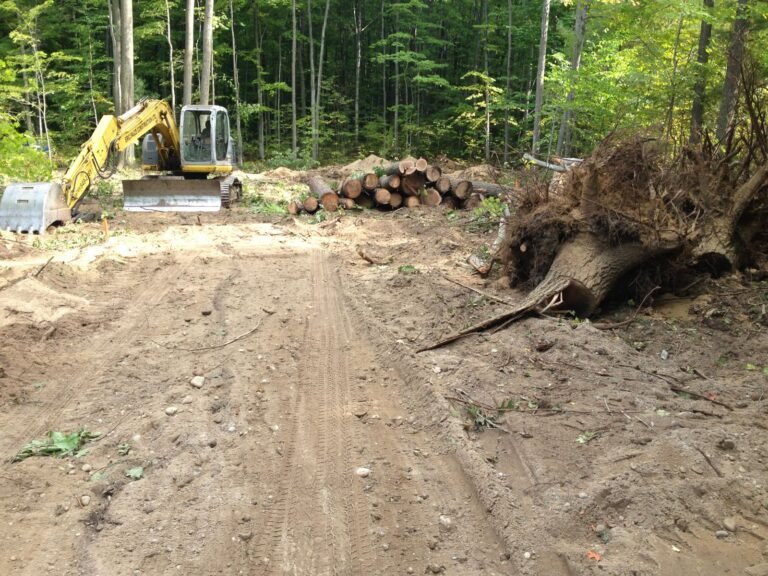
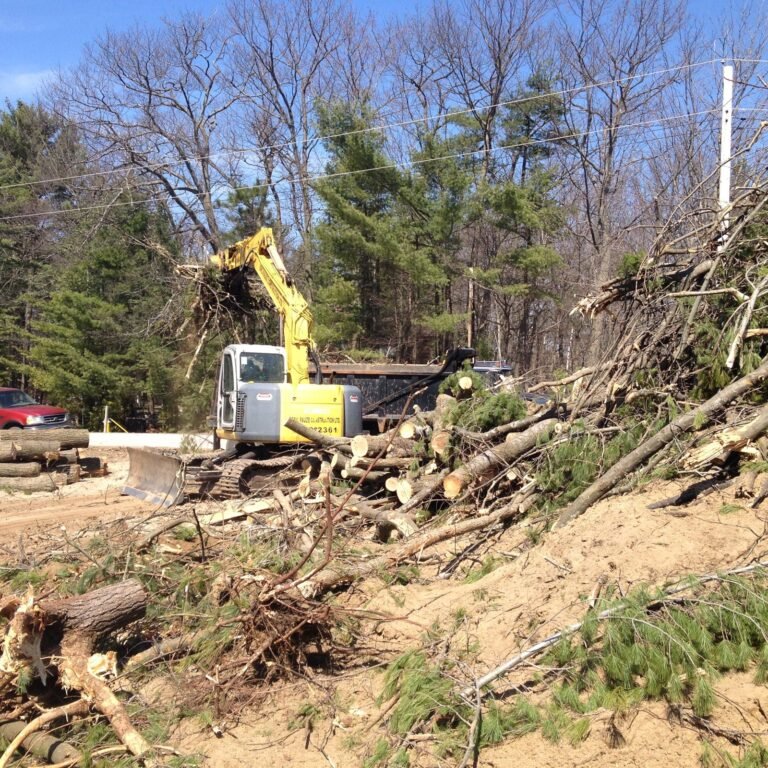
On a Georgian Bay or Simcoe County property being cleared ahead of a build, stump removal is not a standalone service that gets scheduled after clearing is complete. It is part of the clearing scope — and the most efficient time to address it is when clearing equipment is already on site, access is open, and the full lot layout is visible.
Addressing stumps as part of an active clearing project has real practical advantages. The excavator that cleared trees can be used for root ball extraction in build zones without a separate mobilization. Grinding equipment can follow the clearing crew across the lot while access is at its best. Debris from grinding can be mixed with brush and chip material rather than handled separately. The cumulative cost of doing stump work during clearing is almost always lower than doing it as a separate scheduled return visit after the clearing crew has left.
Stumping during clearing
Equipment already on site. Access is at its best across the full lot. Debris can be combined with clearing material. No separate mobilization cost. Scope can be adjusted in real time as the lot opens up and problem areas become visible.
Stumping as a separate return visit
Separate mobilization cost. Access may be reduced if other work has started. Stump locations may be harder to identify once the lot is partially developed. Cost per stump is typically higher without clearing equipment already on site.
For properties where clearing, stumping, grading, and driveway construction are all needed, planning them as a coordinated sequence through a single crew produces a cleaner result at lower total cost than contracting each phase separately. This is covered in detail on the site preparation page — the sequencing of site work phases is one of the most underestimated factors in keeping a rural build on budget.
What happens to the grinding debris — and why it matters
Stump grinding produces a significant volume of wood chip and soil material — sometimes called stump grindings or grinding mulch. On a single residential stump this is a manageable pile. On a lot clearing project with dozens of stumps, the volume of material produced is substantial and needs to go somewhere.
The options for handling grinding debris affect both the cost and the finished state of the site. On properties where the debris can be spread across naturalized or wooded areas not in the active build zone, it can be left on site at no additional disposal cost. It breaks down over time and is not harmful in areas that will not be built on. On properties where the build zone occupies most of the lot or where material cannot be left on site for other reasons, grinding debris needs to be hauled away — which adds a separate cost for loading and disposal.
Grinding debris should never be used as fill in structural areas — building pads, driveway bases, or septic zones. It is organic material that will compress and decompose. Spreading it in a non-build area or hauling it away is always the right choice over using it as fill in a location where stable, compactable ground is required.
On properties where cleared timber is being milled on site — one of the services Georgian Bay Siteworks offers on applicable lots — the overall volume of debris from the clearing and stumping process is reduced, since usable log material is processed into lumber rather than chipped. For lots with quality timber, that option can change the economics of the whole clearing scope and is worth discussing during the initial site walk. More on how that process works is covered on the lot clearing page.
Stump grinding on waterfront and conservation-regulated properties
Many Georgian Bay properties sit near water, wetlands, or other features regulated by the Nottawasaga Valley Conservation Authority or local municipalities. On those properties, tree removal — and therefore stump removal — may require an approval before work begins. That applies to stump grinding as much as it applies to felling the tree in the first place.
The regulations vary depending on the proximity to water, the type of vegetation being removed, and the specific conservation authority jurisdiction. In general, work within a regulated setback from a shoreline, wetland, or ravine feature requires a permit application and approval before anything is removed. Proceeding without that approval on a regulated property is a bylaw violation that can result in stop-work orders, fines, and required remediation — none of which are cheaper than the permit process that was being avoided.
Local experience: waterfront and near-water properties in Georgian Bay are some of the most regulated environments for land clearing work in Ontario. Georgian Bay Siteworks handles NVCA permit coordination as part of clearing and stumping projects on regulated properties — the permits and approvals page covers what that process typically involves and how long it takes. The NVCA website publishes current permit requirements for properties within their jurisdiction.
On shoreline properties where stump removal is permitted, the method matters. Full excavated root removal near a shoreline requires careful management of soil disturbance to prevent erosion and sediment movement toward the water. Those requirements affect how the work gets done, what equipment is appropriate, and how the ground is restored afterward — all of which affect cost on a regulated waterfront site compared to the same work on an inland property.
What to ask before accepting a stump grinding quote
Stump grinding quotes can vary significantly between contractors not because the job is complicated but because the scope being priced is not always the same. Before accepting any price, make sure you have clear answers to these questions:
- Is this surface grinding to a standard depth, or full root removal and excavation? Those are different jobs at different price points.
- What depth will the stump be ground to, and is that sufficient for the intended use of the area?
- Is debris removal included, or does grinding material stay on site?
- Is backfill and site restoration after removal included, or is the hole left open?
- Is the quote based on seeing the stumps in person, or on measurements and descriptions only?
- Does the price include mobilization, or is that a separate charge added to the per-stump rate?
- If the root system is larger or more complex than expected when the job begins, how are changes handled — fixed price or time and material?
That last question matters most on older properties with mature trees, where the visible stump diameter does not always reflect how extensive the root system below grade actually is. A contractor who commits to a fixed price on full root removal without seeing the stump and doing at least a basic assessment of root spread is making an optimistic assumption that may not survive contact with the actual job.
Common stump grinding mistakes that create expensive problems later
| Mistake | What happens next | Why it costs more |
|---|---|---|
| Surface grinding in a future building or driveway zone | Remaining root system decays underground, causing settlement and soft spots in the finished surface above. | Remediation after a driveway or building pad is finished costs far more than full removal during clearing. |
| Using grinding debris as fill in structural areas | Organic material compresses and decays, causing uneven settlement in the fill zone above it. | Excavation, removal of problem fill, and re-compaction with suitable material is a significant unplanned cost. |
| Scheduling stump grinding separately from lot clearing | Separate mobilization costs apply and access may be reduced by other work that has started on site. | Per-stump effective cost is higher without clearing equipment already on site to assist with root extraction. |
| Not asking what depth the stump will be ground to | A shallow grind leaves more root mass in the ground than expected for the intended use of the area. | A return visit for deeper grinding or excavation costs more than specifying the correct depth upfront. |
| Ignoring conservation authority rules near water | Work proceeds without required approval and gets stopped with a compliance order. | Stop-work orders, fines, and mandated remediation always cost more than the permit process being avoided. |
Need stumps removed properly — not just out of sight?
Surface grinding and full root removal are different jobs for different situations. Tell us what the area is being used for and we will tell you what the right scope is — and give you a written price that covers the actual job, not just the visible part of it.
Keep Reading
Frequently Asked Questions
How much does stump grinding cost in Ontario in 2026?
A single small stump under 30 centimetres in diameter typically runs $150 to $350 in Ontario in 2026. Medium stumps of 30 to 60 centimetres range from $300 to $600. Large mature stumps over 60 centimetres, particularly hardwood species requiring full root removal, commonly range from $500 to $1,200 or more. Lot clearing projects with multiple stumps are usually quoted as part of the broader clearing scope rather than per stump, and the effective per-stump cost is lower when equipment is already mobilized on site.
What is the difference between stump grinding and stump removal?
Stump grinding uses a machine to chew the stump down to 20 to 30 centimetres below grade. The root system remains in the ground and decays over time. Stump removal involves excavating the stump and the primary root ball entirely and backfilling the hole with suitable material. Grinding is sufficient for areas that will become lawn or naturalized yard. Full removal is required wherever the ground needs to be stable and free of decaying organics — building pads, driveways, and septic zones.
Can I just grind the stump if I am building a driveway there?
No. Surface grinding leaves the root system in the ground where it will decay and cause settlement under the driveway base over time. A driveway built over ground-only stumps will develop soft spots, ruts, and base failures as those roots break down beneath it. Full root removal is required in any area that will carry a compacted base and traffic load. The cost of proper removal during site preparation is always less than the cost of repairing a driveway built over buried organics.
Does stump size really affect the cost that much?
Yes — significantly. Grinding time scales roughly with the surface area of the stump face, not just the diameter. A stump twice as wide takes approximately four times as long to grind to the same depth, because the machine has to cover four times the area. A ninety-centimetre mature maple stump is many times the work of a thirty-centimetre poplar, and pricing that difference accurately requires seeing the stump, not just hearing the diameter.
Is it cheaper to grind stumps during lot clearing or as a separate job?
Almost always cheaper during clearing. Equipment is already on site, access is at its best across the full lot, debris can be combined with clearing material, and there is no separate mobilization cost. A return visit for stump grinding after clearing is complete adds mobilization cost, may face reduced access if other work has started, and typically produces a higher effective per-stump cost than addressing them during the active clearing phase.
What happens to the wood chip material after stump grinding?
Grinding produces a mix of wood chips and soil. On most rural properties it can be spread in non-build areas — naturalized yard, wooded margins, or low spots not in the active development zone — at no additional cost. It should never be used as structural fill under driveways, building pads, or septic zones. If it cannot stay on site, it needs to be hauled away, which adds a loading and disposal cost to the grinding price.
Do I need a permit to grind stumps near Georgian Bay?
On regulated properties near water, wetlands, or other conservation authority features, possibly yes. The Nottawasaga Valley Conservation Authority regulates tree and vegetation removal within setback distances of shorelines and regulated features. Stump removal on a regulated property may require an NVCA permit before work begins, even if the tree itself has already been removed. If your property is near water, confirm the permit requirements before scheduling any stump work.
How deep does stump grinding need to go?
Standard grinding depth is typically 20 to 30 centimetres below grade. That is sufficient for areas that will become lawn or naturalized yard. For areas that will be graded or filled, deeper grinding or excavated root removal may be required depending on the fill depth and the intended use. For building pads, driveway bases, and any structural application, full excavated root removal is the appropriate method regardless of how deep a grinder can reach.
Can hardwood stumps be ground the same way as softwood?
Yes, but they take longer and wear grinding equipment faster. Hardwood species — maple, oak, ash, beech — are significantly denser than softwood species like pine, spruce, or poplar. A hardwood stump of the same diameter as a softwood one takes more time and more passes to process to the same depth. That difference shows up in the cost, particularly on lots with mature mixed hardwood cover, which is common throughout Simcoe County.
What is the best time of year for stump grinding in Ontario?
Stump grinding can be done in any season, but spring and fall tend to produce the best ground conditions for access and site restoration. Summer work is straightforward on dry ground. Winter grinding on frozen ground is possible and can actually be easier for equipment access in soft ground areas, though site restoration and backfilling typically wait until ground conditions allow proper compaction. Early spring with frost coming out of the ground is the most difficult time for any ground disturbance work in Ontario.