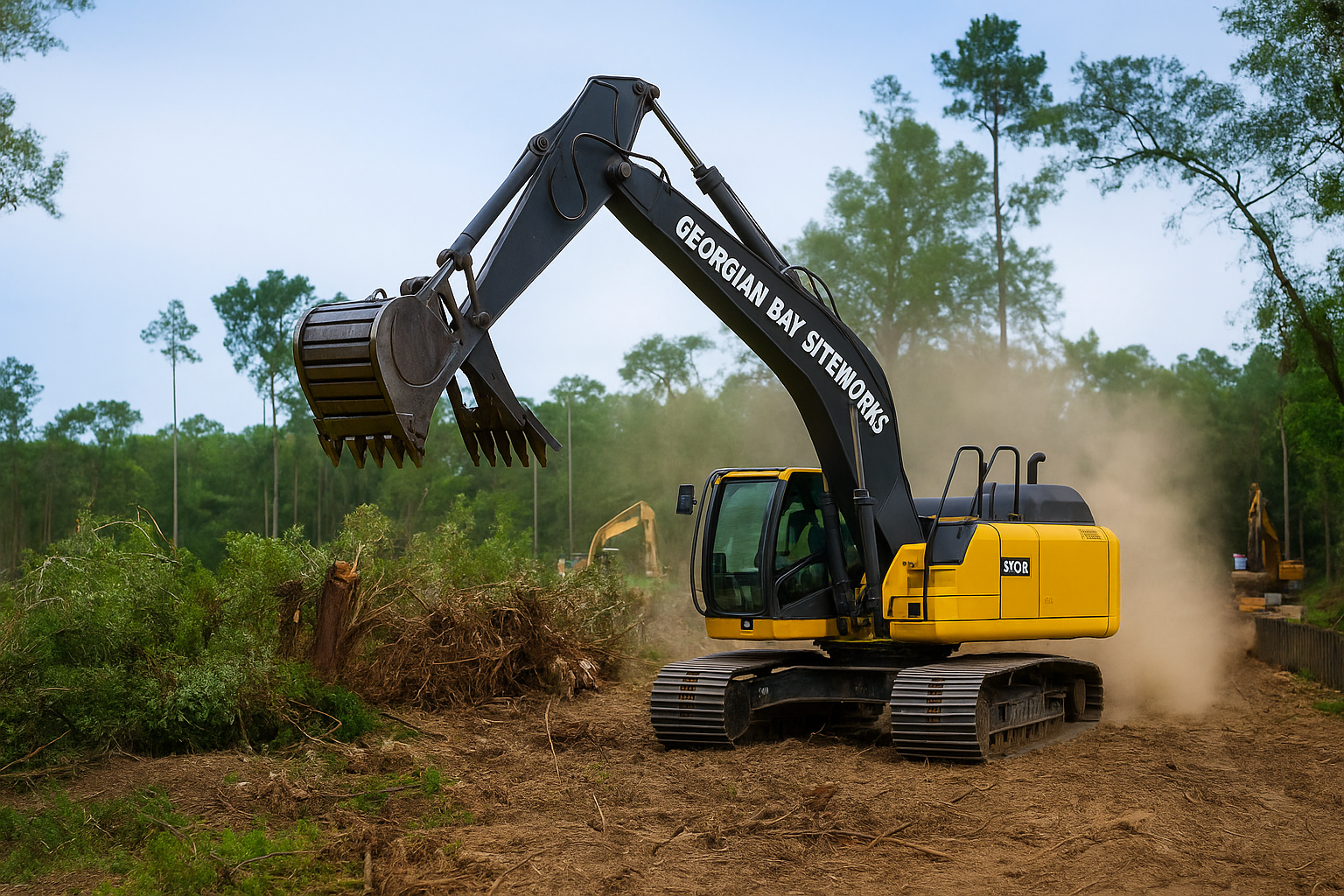
Trenching Services Georgian Bay: Water, Power, Drainage, and the Stuff That Has to Be Buried Properly
Trenching sounds simple until somebody picks the wrong route, digs before the locates are in, or realizes too late that the driveway, septic area, drainage plan, and buried services are all fighting for the same ground. This page is about getting trenches planned and dug the right way before the rest of the site work boxes you in.
There are parts of a build everybody notices, and then there are parts nobody notices unless they go wrong. Trenching falls squarely into that second category. Nobody pulls into a new property and says, “Look at those beautiful buried service routes.” But if the water line freezes because the route was foolish, or the hydro trench got dug after the driveway was already finished, suddenly trenching becomes very memorable.
That is why trenching has to be treated like planning work, not just digging work. A trench is not simply a narrow excavation in the ground. It is a decision about where water comes from, where power comes in, how drainage leaves, how future repairs happen, and whether the site layout still makes sense after everything is buried.
In Georgian Bay and surrounding areas, trenching can also get more interesting than people expect. Rock, roots, slopes, wet areas, long service runs, and rural lot layouts all change how trench routes should be planned. A line that looks obvious on a site sketch can become the worst possible place to dig once machines are on the ground and the rest of the work is underway.
Trenching is one of those jobs that gets expensive when done at the wrong time
The biggest trenching mistake is not always depth or equipment choice. A lot of the time, it is sequence. The trench gets left too late. Then the driveway is already roughed in, the grading is partly done, the access is tighter, the septic area is protected, and suddenly the “easy trench” is no longer easy. Now the route is awkward, the machines have less room, and the site has more to lose.
This is why trenching belongs in the same early conversation as access, grading, septic planning, and building placement. If you want the larger pre-build picture, it ties directly into site preparation before building, because buried services are one of the things that get awkward fast when the order of operations is wrong.
What trenching services usually cover on a Georgian Bay property
Not every trench is for the same thing, and not every line belongs in the same route. Some trenches are for water services. Some are for hydro. Some are for drainage or sleeves for future work. On rural properties, trenching may also tie into pump lines, outbuildings, detached garages, garden suites, or site drainage that needs to move water away from the house and road access.
Common trenching scopes
Water services, hydro services, conduits, drainage lines, sleeves, site lighting feeds, connections to outbuildings, and service runs that need clean routing across larger rural lots.
Why route planning matters
The shortest line is not always the smartest line. Good routing avoids future conflicts with driveways, retaining areas, septic zones, and places you may need to dig again later.
That is also why trenching rarely lives as a completely separate service. It overlaps with excavation services, grading and drainage, and even driveway and private road work, because the trench route and the final site layout need to cooperate.
Water lines, hydro, and drainage do not like being planned as an afterthought
If a property needs a water service, buried hydro, and site drainage, those routes should be looked at together. Otherwise the lot ends up with criss-crossed trenches, awkward crossings, or service lines buried where future repairs will be miserable. Nobody wants to tear up a finished access road or carefully graded yard because the original trenching layout was improvised.
Some of the questions that should be answered early are pretty simple:
- Where does the service enter the building or structure?
- Will this trench route be affected by future grading or retaining work?
- Does it cross a driveway, septic area, or drainage swale?
- Can the route be reached later for repair without destroying the whole site?
- Should sleeves or spare conduits be added while the trench is open?
That last point matters more than people think. When a trench is open, it is often the best and cheapest time to think a step ahead. A spare conduit or a better route today can save a surprising amount of aggravation tomorrow.
Locates first. Digging second. This should not be controversial.
Before trenching starts, buried infrastructure has to be taken seriously. In Ontario, that means utility locates. It is not optional, and it is not something to “probably be fine” your way through. Existing wires, pipes, and cables have no sense of humour, especially when hit with a machine bucket.
For property owners and contractors alike, the smart move is simple: get the locates in place and make sure the route is actually clear before excavation starts. The same common-sense caution applies whether you are trenching for a new build, an outbuilding, a detached garage, drainage, or a future service sleeve.
Permits and approvals can also affect trenching, especially when services tie into the building permit process or other site work that is being reviewed locally. For the broader Ontario side of that, see How to Obtain a Building Permit in Ontario, Zoning Rules for New Homes in Ontario, and the Ontario Building Code.
Georgian Bay trenching gets more interesting because the ground is rarely boring
If you are trenching in the Georgian Bay area, the ground conditions can change from one property to the next, and sometimes from one end of the same property to the other. Sand, rock, roots, wet pockets, fill, and tight wooded access all change what the job looks like.
Rock and shallow bedrock
These can change route choice, digging method, machine time, and what makes the most sense for protecting the service line.
Wet or soft ground
This affects access, trench stability, spoil placement, and whether the site stays workable while the trench is open.
Tree roots and wooded lots
These make route planning more important, because a bad line can damage trees worth saving or create a trench that is harder to excavate cleanly.
Long rural runs
These need better planning for elevation, routing, crossings, and future serviceability than short suburban service trenches.
This is exactly why trenching is not just a “dig it where it fits” job. The route has to make sense for the land you actually have, not the easy drawing somebody imagined from the truck window.
Spoil handling matters more than most people think
Every trench creates spoil. That is obvious. What is less obvious is how quickly spoil becomes a site problem when there is no plan for it. Put the material in the wrong place and it blocks access, damages the future yard, interferes with grading, or creates a muddy, unstable mess the next time it rains.
Good trenching should account for:
- where the excavated material will be stockpiled,
- whether it can be reused or needs to be hauled away,
- how close it should be to the trench edge,
- how it affects machine movement and access, and
- whether it interferes with drainage or other active work on site.
A well-run trenching job does not just leave a line in the ground. It leaves the site still workable when the trench is done. That sounds basic, but basic is often what saves the day.
Drainage trenches are not decorative ditches
When trenching is tied to drainage, the route and elevation become even more important. Drainage lines need somewhere sensible to go, and they need to work with the grading plan rather than against it. If the site drainage is poorly thought out, you can end up moving water to the wrong place more efficiently, which is a strange achievement but not a useful one.
That is why drainage trenching should be tied into the overall grading strategy. On many rural properties, there is a real relationship between trenching, lot shaping, foundation drainage, road runoff, and where surface water is being encouraged to move. For the broader picture, see Grading and Drainage Georgian Bay.
Trenching around septic systems and outbuildings needs a little more thinking
Rural lots often have more going on than a single house service. There may be a septic system, a detached garage, a future shop, or a garden suite. That means trench routes cannot be planned in isolation. They have to respect the layout of the whole property.
If a trench crosses or crowds the wrong area, you can create conflicts with a septic layout, future access, or a later service run to another structure. That is one reason trenching for detached buildings, service yards, and future expansions should be looked at early, especially if the owner already knows the site may grow in phases.
This ties into septic system planning and also into future structures such as a detached secondary building or living space. If that is part of the bigger plan, garden suite planning and broader new-build coordination through ICFhome.ca can help keep the property layout from being painted into a corner.
The order of trenching work should make the rest of the project easier
The best trenching jobs are the ones nobody has to think about later. That usually means the work happened in the right order. A practical sequence often looks like this:
- Review the site plan for house location, driveway, drainage, and service entry points.
- Confirm locate information and make sure the route is actually ready to excavate.
- Plan the trench path around septic zones, future structures, and access routes.
- Choose spoil areas that do not wreck the site or block other work.
- Install services and sleeves while the trench is open and access is good.
- Backfill and restore properly so the site stays stable and ready for the next trade.
What homeowners and builders usually get wrong about trench routes
| Mistake | What happens next | Why it hurts |
|---|---|---|
| Leaving trenching too late | The route has to work around finished or semi-finished site work. | Everything gets slower, uglier, and more expensive. |
| Choosing the shortest line instead of the smartest line | The trench crosses future conflict areas. | Repairs and future work become a headache. |
| No spoil plan | The site gets blocked, muddy, or damaged. | The trench is done, but the rest of the property is harder to work on. |
| Ignoring drainage while routing utilities | Water problems show up later around the trench or nearby grades. | Buried services and poor water control are a miserable combination. |
| Forgetting future phases | New trenches later have to cut through completed areas. | You pay more because nobody thought one step ahead. |
Good trenching is really about foresight
At the end of the day, trenching is one of those services that looks simple only when it has been thought through properly. The machine still has to dig the ground, of course. But the real value is in getting the route right, the sequence right, the site coordination right, and the backfill and restoration right so the rest of the project can move forward without surprises.
That is especially true on Georgian Bay properties, where the land can be beautiful, challenging, awkward, rocky, wet, wooded, or all of the above in one afternoon. Good trenching respects those conditions instead of pretending every lot is a flat suburban rectangle with no future plans.
If the trench route is smart, the buried services disappear into the background the way they should. That is the goal. Quiet success. No drama. No ripped-up driveway later. No emergency digging where nobody wanted it. Just water, power, drainage, and utilities buried where they make sense.
Need trenching done before the site gets boxed in?
Plan the routes before roads, grading, septic work, or new structures make the job harder than it needs to be. Smart trenching is not just digging. It is making the rest of the project simpler.
Frequently Asked Questions
What kinds of trenching do you typically do on Georgian Bay properties?
Trenching work commonly includes water services, hydro runs, conduit installation, drainage lines, sleeves for future services, and site utility routes to houses, garages, shops, and other structures. The exact scope depends on the property, but the biggest goal is always the same: get buried services where they make practical sense before other work makes those routes harder to install.
Why should trench routes be planned before other site work?
Because trenching gets more expensive when roads, grading, structures, and septic areas are already in place. Early planning keeps the route cleaner, protects the rest of the site, and lets you add sleeves or future-ready conduits while the ground is already open.
Do I need locates before trenching?
Yes. Existing buried infrastructure has to be identified before excavation starts. That applies whether the trench is for a new utility run, drainage, an outbuilding connection, or another buried service. Digging first and hoping for the best is a terrible strategy.
Can water, hydro, and drainage all be routed together?
Sometimes parts of the routing can be coordinated, but they should never be treated as a careless bundle of “stuff in the ground.” Each service has its own practical requirements, and the full route should be planned so it remains safe, serviceable, and compatible with the rest of the site layout.
What makes trenching harder in Georgian Bay?
Rock, shallow bedrock, tree roots, wet areas, long service runs, and limited access are all common factors. Those conditions change the route, the digging method, the spoil plan, and how much room there is for machines to work efficiently.
Why does spoil handling matter so much on trenching jobs?
Because every trench creates material that has to go somewhere. If the spoil is dumped in the wrong place, it can block access, damage the site, interfere with grading, or create a muddy mess. Good spoil handling keeps the whole project moving instead of creating a second problem beside the trench.
Should I add spare conduit while the trench is open?
Very often, yes. If there is a reasonable chance you may want future lighting, gate power, internet, outbuilding service, or another line later, an open trench is usually the cheapest and easiest time to think ahead. It is much nicer than digging through a finished driveway later.
How does trenching relate to septic and drainage planning?
Trench routes need to respect the overall site plan. That means they should not create conflicts with septic components, drainage paths, grading plans, or future building zones. Trenching done in isolation can create layout problems that are much harder to fix once the lines are buried.
Can you trench for detached garages, shops, or future secondary structures?
Yes, and those jobs benefit even more from early planning because the route may need to work around current site features and future phases of the property. Detached structures are exactly where smart routing pays off later, especially if the owner expects the lot to evolve over time.
What is the biggest trenching mistake property owners make?
The biggest mistake is treating trenching like a small standalone task instead of part of the larger site plan. When the route, sequence, and future use of the property are ignored, trenching often ends up costing more and making the site harder to finish cleanly.