When the Old Septic System Stops Being “Fine” and Starts Becoming Expensive
A septic system can spend years acting like a tired old pickup truck. It still starts. It still moves. It still convinces you everything is okay. Then one spring, the drains slow down, the yard smells wrong, the ground gets soggy where it should not, and suddenly “we’ll deal with it later” becomes the most expensive sentence on the property.
If you are looking into septic replacement in Georgian Bay, you are probably trying to answer one practical question: do we keep repairing this thing, or has replacement finally become the smarter move? This article walks through the warning signs, the repair-vs-replace decision, the site limitations that matter on older lots, and the real sequence of how a replacement job usually unfolds.
The big misconception is that septic replacement is just a tank swap. It usually is not. On older Georgian Bay properties, replacement is often a site-planning exercise, an excavation project, a layout problem, and sometimes a negotiation with a lot that has become much less cooperative over the years.
The short answer
If repairs keep buying you only a little time, replacement often wins because it solves the actual problem instead of paying rent to it every year.
Why Georgian Bay is tricky
Older properties here often have rock, slope, mature trees, tight access, shoreline sensitivity, and very little extra room for a modern layout.
What smart owners do
They stop thinking about the septic system as one buried object and start treating it like a full sitework project with sequencing, logistics, and future planning.
Repair feels cheaper right up until it isn’t
No one wakes up hoping to replace a septic system. Repair sounds friendlier. Repair sounds smaller. Repair sounds like a problem we can solve with one truck visit, a receipt, and a relieved sigh.
Sometimes that is true. A component fails, a lid issue gets fixed, a service problem is corrected, and you move on. But older systems have a bad habit of turning repairs into a monthly subscription nobody wanted.
That is the line homeowners need to watch. If you are repeatedly paying to manage symptoms instead of restoring reliable function, you may not have a repair problem anymore. You may have a replacement problem wearing a fake moustache.
If you need the broader background first, start with Septic Systems Georgian Bay and Septic Systems Ontario. Those pages help frame what a functioning system should be doing before you decide whether yours still qualifies as “functioning.”
The warning signs are usually obvious — we just talk ourselves out of them
Older systems rarely send a polite written notice. They usually communicate the old-fashioned way: by smell, soggy ground, sluggish plumbing, or a performance pattern that keeps getting worse.
And homeowners do what homeowners do. We explain it away. It was a wet spring. Maybe the tank just needs pumping. Maybe the kids had too many people over. Maybe the ground always smelled like that. No, it didn’t.
- Slow drains that keep returning after service are not a personality trait.
- Backups are never a “monitor it and see” situation.
- Wet or lush patches in the wrong place can signal effluent where you do not want it.
- Yard odours are your system’s version of waving a red flag.
- Frequent pumping with no long-term improvement usually means you are buying time, not fixing capacity or dispersal issues.
Older cottages converted to year-round use are especially vulnerable. The system may have been acceptable for occasional seasonal use years ago, but that does not mean it still matches how the property is used today.
On older Georgian Bay lots, the real issue is often not the old system — it is the lot around it
This is where septic replacement gets interesting. Or annoying. Usually both.
Many older properties were developed long before today’s expectations for year-round use, accessory buildings, expanded footprints, parking, landscaping, and all the other things owners now want from a property. The lot may have less free space than it appears. Trees got bigger. Driveways got wider. Additions were added. Shoreline setbacks matter. Access got tighter. Suddenly replacing the septic is no longer a simple “put the new one where the old one was” exercise.
| Lot condition | Why it matters during replacement | What it can trigger |
|---|---|---|
| Tight lot or mature landscaping | Less room to lay out a modern replacement area | Design compromise, more careful excavation, extra site disturbance |
| Shallow rock or poor native soil | Limits what can be done at natural grade | More imported material, raised areas, different bed strategy |
| Slope or runoff issues | Complicates grading and water management | Extra shaping, drainage work, and layout decisions |
| Restricted access | Makes tanks, material, and equipment harder to move | Longer install time and higher sitework cost |
| Changed property use | The old system may no longer suit the way the home is used | Replacement rather than repeated maintenance |
That is why replacement pricing and replacement planning overlap so heavily with Septic System Cost Georgian Bay and Excavation Services Georgian Bay. By the time you are replacing, the question is not just “what system do we want?” It is also “how do we physically make this work on this property?”
Replacement wins when the repair money is protecting the wrong thing
Here is the honest version. People often compare a small repair number against a much larger replacement number and decide the repair is the sensible choice. On paper, that feels logical. In practice, it can be completely wrong.
The real comparison is not one repair bill versus one replacement bill. It is:
- ongoing service calls
- repeated pumping
- property disruption
- risk of failure during the busiest season
- worsening lot conditions
- and the chance you still end up replacing the system anyway
That is when replacement starts to look less like a painful expense and more like a strategic decision. You stop feeding an aging system that has clearly begun to lose the argument.
If the replacement ends up needing a more modern dispersal approach, pages like Filter Bed Septic System Ontario help explain why the replacement layout can look very different from what was installed decades ago.
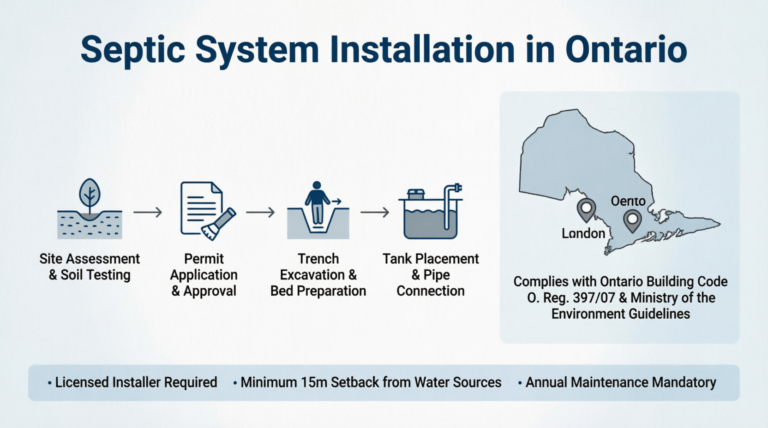
The sequence matters: good septic replacement jobs are planned, not improvised
Homeowners sometimes picture septic replacement as one excavator, one tank, one messy week, and done. Sometimes it goes that smoothly. Often, though, the success of the job depends on sequence.
- Confirm the symptoms and the goal. Are we chasing one component issue, or are we looking at overall system age, failure signs, and a lot that no longer supports wishful thinking?
- Review the lot. Access, slope, trees, driveways, rock, setbacks, existing services, and room for replacement all matter.
- Figure out the practical layout. The new system may not belong where the old one lived.
- Coordinate the excavation scope. Replacement often overlaps with grading, clearing, temporary access, spoil handling, and imported material.
- Install with the bigger site in mind. You do not want a septic replacement that solves one problem while creating three new ones around access, drainage, or future building plans.
- Finish the site properly. This is not just cleanup. Grading, contours, and protection of the replacement area are part of doing the job right.
That is one reason replacement projects often intersect with site preparation in Simcoe County. The septic system does not exist in isolation. It has to work with the rest of the property and whatever else you are doing there.
Timing can save you money, stress, and one truly miserable weekend
The worst time to seriously think about septic replacement is when the property is full, the ground is saturated, guests are arriving, and the system has chosen violence.
The better time is when you can still make decisions instead of emergency concessions. If the system is showing obvious age and decline, replacing before total failure usually gives you more control over schedule, site access, layout options, and coordination with other property work.
Timing matters even more on older properties that may also be flirting with zoning, addition, or accessory dwelling questions. If you are planning a new structure or expanded use, septic capacity and lot layout need to be part of that conversation early. See Zoning Rules for New Homes Ontario and Garden Suite Septic Requirements Ontario for the broader planning side.
Replace earlier when…
The system is aging, performance is slipping, and you already know the property is changing or being used harder than before.
Emergency replacement happens when…
Everyone ignored the signs until the system forced the issue at the least convenient time imaginable. Septic systems have excellent comedic timing, unfortunately.
What homeowners should expect during a real replacement conversation
A useful replacement discussion is not just about price. It is about what is failing, how the property is laid out, what work the lot will require, and whether this is a good time to coordinate other site improvements.
You should expect questions about:
- the age of the current system
- what symptoms you are seeing and how often
- whether the property is seasonal or year-round
- lot access for equipment and tank delivery
- grading, drainage, slope, and rock conditions
- future plans for additions, garages, suites, or other site changes
And if you are already doing permit-stage planning for the home itself, it often helps to keep the larger site package in view, including items like Mechanical Drawings Ontario and Building Permit HVAC Requirements Ontario. Different systems, yes — but the smartest projects coordinate them instead of treating each one like a surprise visitor.
Sometimes the smartest septic repair is finally admitting it is not a repair job anymore
That is really the heart of septic replacement on older Georgian Bay properties. There comes a point where continued repairs are not protecting value. They are delaying an inevitable decision while the lot gets busier, the symptoms get louder, and the timing gets worse.
Replace before the system picks the date for you. It is almost never considerate about it.
Bring this info before asking about replacement
- Property address and rough lot sketch or survey
- Age of existing system, if known
- Description of symptoms and how long they have been happening
- Notes on slope, wet ground, rock, and access
- Any planned addition, suite, or major site changes
- Whether this is a seasonal or year-round property
Frequently Asked Questions About Septic Replacement in Georgian Bay
How do I know whether my septic system needs repair or full replacement?
If the issue is limited to one serviceable component and the system otherwise performs reliably, repair may be reasonable. But if you have repeated backups, odours, soggy ground, frequent pumping, and no lasting improvement, replacement starts making a lot more sense. The key is whether you are fixing one problem or financing a pattern.
Do older cottage properties in Georgian Bay often need replacement instead of repair?
Quite often, yes. Many older systems were installed for seasonal use or under very different site expectations. Once those properties become year-round homes or see heavier use, the old system may no longer match the demand or the realities of the lot.
Can a replacement system go exactly where the old one was?
Sometimes, but not always. On older lots, the best replacement area may be different because of access, grading, soil conditions, rock, landscaping, or current site layout. Assuming the new one will fit neatly where the old one sat is one of the fastest ways to underestimate the job.
Why does septic replacement often turn into an excavation project too?
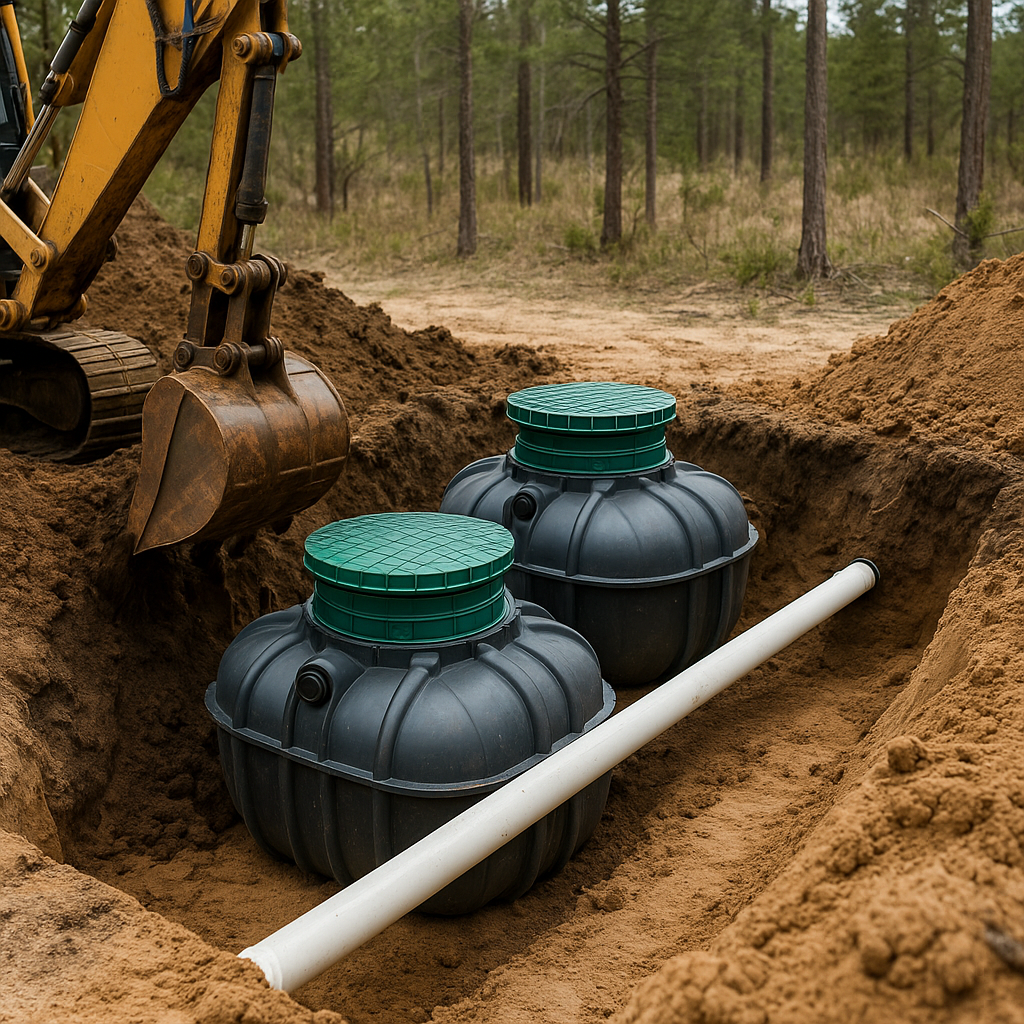
Because it usually involves much more than swapping one buried component. Access for machines, tank placement, removal or bypass of old elements, imported material, grading, and shaping the replacement area are all part of the work. The lot itself often drives the effort more than the equipment list does.
Is replacement cheaper if I do it before total failure?
It can be, especially if early timing gives you more control over access, schedule, and coordination with other work. Emergency replacement tends to happen at the worst possible time, when the ground is wet, the property is busy, or the problem is already disrupting daily life. That kind of timing rarely improves either stress levels or efficiency.
Can future additions or a garden suite affect septic replacement decisions?
Yes. If you think you may add a suite, accessory building, or major addition later, it is worth discussing now. Replacement is one of those moments where planning ahead can save a lot of regret. A lot that barely solves today’s septic problem may not leave room for tomorrow’s plans.
Does a replacement always mean a filter bed?
Not always, but modern replacement layouts on constrained or challenging lots can involve very different dispersal solutions than older systems had. The right approach depends on the lot, the soil, the site conditions, and the practical layout. That is why replacement should be viewed as a full design-and-sitework conversation, not just a product choice.
What should I gather before asking about septic replacement?
Bring the property address, any lot sketch or survey, what you know about the current system, the symptoms you are seeing, and any notes about access, rock, wet areas, slope, or future building plans. Good information early makes the replacement conversation much more useful.