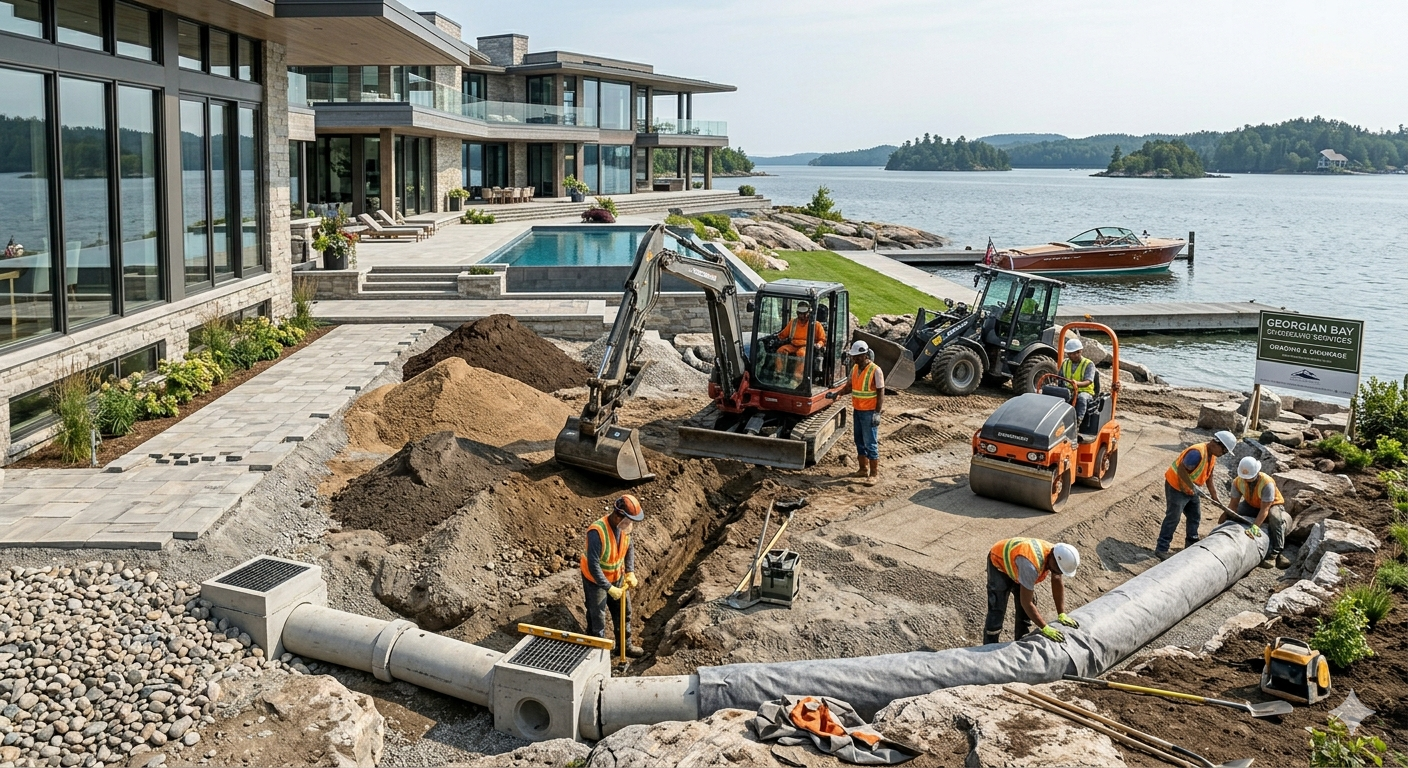
Grading and Drainage Georgian Bay: Move Water the Right Way Before It Moves Your Budget
Water is patient, sneaky, and expensive. It does not need a dramatic flood to cause trouble. Sometimes all it takes is a little negative slope, a soft shoulder along a driveway, a low area beside the house, or spring thaw finding the one lazy grading decision made six months earlier. Then the puddles start. Then the rutting starts. Then the wet crawlspace, the icy walkway, the driveway washout, the muddy septic area, or the foundation problem that suddenly costs real money.
That is why proper grading and drainage in Georgian Bay is not decorative work. It is site control. It is the difference between a property that sheds water calmly and one that keeps trying to re-engineer itself every spring.
What proper grading should do
- Move water away from the house
- Protect driveways and access roads
- Reduce ponding and frost problems
- Keep site work from undoing itself
Where sites usually fail
- Negative grade beside foundations
- Flat lawns that hold thaw water
- No swale to intercept runoff
- Driveway edges that unravel every spring
Why this matters early
Bad grading does not stay in its lane. It affects excavation, base prep, septic performance, driveway life, landscaping, foundation comfort, and what the site costs to maintain later.
Positive drainage is boring until you do not have it
Most site drainage problems are not mysterious. Water follows gravity, and if the site does not tell it where to go, it picks its own route. Usually that route is the one you least wanted. Back toward the house. Across the driveway. Into the garage apron. Over the lawn. Down into the soft area beside the septic bed. Or straight into the low pocket where you were hoping to put topsoil and call it landscaping.
Positive drainage means the finished grade actually falls away from important areas rather than trapping water beside them. Around a house, that starts with getting runoff moving away from the foundation zone instead of lingering there. Around the broader site, it means shaping the land so water keeps travelling in a controlled direction, without creating erosion, soft spots, or downstream mess.
Field truth: a nice-looking site can still be a badly draining site. Fresh topsoil and seed can hide lazy grading for one season. Spring usually tells the truth.
That is one reason grading should be part of the site plan from the beginning, not a “clean it up later” item after construction. It connects directly to site preparation before building, excavation sequencing, driveway planning, and where water ends up once the roof, hard surfaces, and disturbed ground all start shedding runoff.
Georgian Bay sites have their own kind of attitude
Grading near Georgian Bay is rarely as simple as pushing soil around until it looks tidy. Local sites often bring rock, thin overburden, wet pockets, mixed elevations, shoreline sensitivity, tree cover, seasonal frost movement, and narrow building envelopes. Some lots drain fast in one area and hold water like a soup bowl ten feet away. Others look dry in August and become a boot-sucking argument in April.
Thaw season is the big reality check. Frozen ground can block infiltration, surface runoff increases, and meltwater finds every low area, wheel rut, and weak shoulder. That is when bad shaping shows up fast. If the driveway crown is wrong, it washes. If the swale is too flat, it ponds. If the house grade is lazy, water hangs near the foundation and starts creating problems you will be paying to “investigate” later.
- Wet sites need direction: water should be intercepted and guided, not left to wander.
- Rocky sites need strategy: limited soil depth changes how grading and runoff control must be handled.
- Thaw season exposes shortcuts: frozen subgrade and soft shoulders punish poor site shaping quickly.
- Driveways are drainage systems too: if they are not crowned or supported properly, they become erosion channels.
Swales, crowns, and runoff control are not optional details
People sometimes hear words like swale and crown and assume this is landscaping jargon. It is not. These are basic water-control tools. A swale is simply a shallow shaped channel that gives water somewhere to travel on purpose. A crown gives a driveway or road surface a slight high point so water sheds off instead of running straight down the middle like a creek with traffic.
Swales
Swales help intercept sheet flow, move runoff around structures, and prevent broad ponding in flat or soft areas. They only work when they actually connect to a sensible outlet and are shaped with enough fall to keep water moving.
Crowns
Crowns protect driveways and private roads by moving water off the running surface. Without them, gravel migrates, potholes form faster, and shoulders start disappearing one rain event at a time.
On many properties, the driveway tells the whole drainage story. If you need help with access and runoff together, it should be planned alongside driveways and private roads in Georgian Bay, not treated as a separate afterthought after trucks have already beaten the route into the ground.
How bad grading creates downstream costs nobody budgets for
Poor grading is annoying at first and expensive later. The first signs are usually minor: puddles, soft lawn edges, damp areas, gravel migration, or a strip of mud that keeps reappearing no matter how much topsoil gets dumped on it. Then those small symptoms start affecting bigger parts of the project.
| Bad grading issue | What it causes | Why it gets expensive |
|---|---|---|
| Low spots beside the house | Ponding, dampness, freeze-thaw trouble | May affect comfort, finishes, and foundation performance |
| Flat or reversed slope | Water runs toward buildings | Usually means rework after landscaping is already done |
| Poor driveway drainage | Rutting, washouts, potholes, soft shoulders | Repeated maintenance and added gravel every season |
| Uncontrolled runoff across site | Erosion, muddy paths, disturbed septic areas | Creates problems in multiple scopes at once |
| No drainage planning during site prep | Temporary fixes become permanent headaches | Costs more because finished work gets undone later |
That ripple effect is exactly why grading belongs in the same conversation as excavation services, lot clearing, and even long-term choices like whether a site is better suited to a basement or a slab approach. On some lots, that bigger decision matters more than people expect, which is why pages like slab on grade vs basement in Ontario become part of the water conversation too.
Grading has to respect the rest of the site, not fight it
Good drainage work is not just about the house pad. It has to fit the whole property. That includes tree cover, access routes, utility trenches, septic layout, natural runoff patterns, and where the site can safely receive water without transferring the problem somewhere worse.
On rural and semi-rural properties, one careless grading move can create a new problem downhill, around the septic system, or along the driveway edge. If the project includes sewage work, grading has to be coordinated with septic systems in Georgian Bay so water is not directed into areas that need to stay stable and perform properly.
Another builder truth: “We’ll fix that with topsoil later” is not a drainage plan. Topsoil is not a substitute for proper shaping, base stability, and controlled water routes.
If the project also includes a foundation build, the site drainage discussion naturally overlaps with structure protection. That is part of why foundation planning and site shaping should talk to each other from the start. Related work like ICF foundation construction and full-build planning through ICFhome.ca becomes much easier when water control is handled early instead of treated as cleanup.
What a proper grading and drainage scope usually includes
Every lot is different, but the work usually begins with reading the site honestly. Where is the high ground? Where is the low ground? Where does runoff naturally want to go? What changes once the driveway, roof, disturbed soils, and cleared areas are introduced? Once those answers are clear, the shaping can be done with purpose.
- Establishing positive fall away from structures and critical areas
- Building or refining swales to intercept and move runoff
- Shaping crowns and shoulders on driveways or private roads
- Correcting low pockets that hold water after rain or thaw
- Protecting base prep so soft areas do not ruin the finished surface
- Coordinating grading with excavation, septic, and site access work
- Planning for spring conditions, not just the dry week when the work is done
This is why our grading work is tied closely to the broader Georgian Bay Siteworks services approach. Water control is not an isolated specialty. It is part of making the whole property function.
Code, permits, and common sense
Formal site drainage requirements can vary by project type, municipality, engineering scope, and what else is happening on the lot. Ontario’s official page states that the 2024 Ontario Building Code came into effect on January 1, 2025, and site-related work should always be coordinated with the actual permit drawings, local requirements, and any engineering or conservation constraints that apply. :contentReference[oaicite:1]{index=1}
In plain English, that means this: do not assume a rough machine pass and a few loads of topsoil count as finished drainage planning. The site should be shaped intentionally, and when a permit set or engineered plan governs the work, the finished grading needs to reflect that.
FAQ: Grading and Drainage in Georgian Bay
Why is grading so important around a new house or cottage?
Because water will always test the easiest route. If the finished grade does not move runoff away from the building, it will linger where you do not want it. That can affect comfort, access, driveway performance, landscaping, and the long-term health of the site.
What does positive drainage mean?
It means the finished ground falls away from the important areas rather than trapping water beside them. Around buildings, that usually means shedding water away from the structure. Across the lot, it means guiding runoff to safer paths and outlets.
Why do Georgian Bay sites often have drainage trouble in spring?
Spring thaw combines meltwater, soft ground, frost-related movement, and reduced infiltration while the soil is still transitioning. That exposes low spots, flat areas, weak shoulders, and any grading shortcuts that were hidden during drier seasons.
Can a driveway really fail because of drainage?
Absolutely. Many driveway problems are drainage problems in disguise. Without proper crown, shoulder support, and runoff control, water starts moving material, softening the base, and creating rutting and potholes much faster.
What is a swale and when do I need one?
A swale is a shallow graded channel that carries water where you want it to go. It is often used to intercept surface runoff, keep water away from structures, and reduce ponding across flatter or wetter sections of the site.
Can bad grading affect septic areas?
Yes. Directing runoff into the wrong place can create soft or unstable conditions and interfere with how surrounding site areas perform. That is why drainage planning should be coordinated with septic layout and not handled as a separate afterthought.
Is topsoil enough to fix drainage problems?
Usually not. Topsoil can finish a properly shaped site, but it does not replace correct grading, subgrade preparation, or water-control planning. If the underlying shape is wrong, the problem usually comes back.
When should grading and drainage be planned?
Early. Ideally during site prep and excavation planning, before the driveway, foundation, and finished landscape lock in the wrong elevations. Water control is much cheaper to plan early than to repair later.
Do wet lots always need major drainage systems?
Not always. Some sites improve dramatically with better shaping, runoff interception, and realistic grading around key areas. Others do need more involved solutions. The right answer depends on the lot, soil, rock, access, and how the property is being used.
What is the smartest next step if my site already holds water?
Start by looking at where the water comes from, where it sits, and what features are influencing it. The fix is rarely just “add more gravel.” The real answer is usually proper site shaping tied to the rest of the project.
The cheapest water problem is the one you prevent
A good grading job does not look flashy. It just works. Water leaves the building. The driveway sheds runoff. The low spots are gone. Spring is less dramatic. The site feels stable. That is the goal.
If your Georgian Bay property needs runoff control, site shaping, driveway drainage help, or a smarter grading plan before construction moves ahead, the right time to deal with it is now, not after the first wet season starts teaching expensive lessons.
Serving Georgian Bay and surrounding areas with sitework that connects grading, drainage, excavation, access, septic coordination, and real-world property preparation into one workable plan.