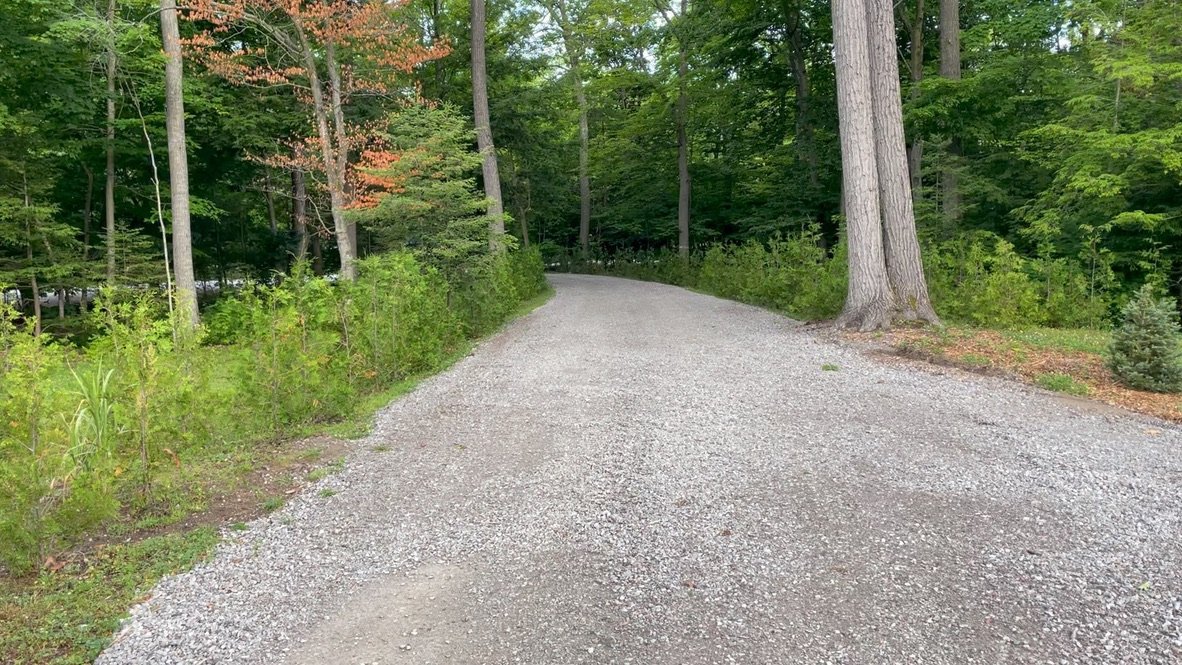
The Road Is Usually the First Build Decision That Decides Whether the Rest of the Project Behaves
A lot can look beautiful on a listing sheet and still be completely miserable once you try to get a concrete truck, excavation equipment, framing crew, septic materials, and your own vehicle onto it in the rain. That is the point where a “simple driveway” stops being a driveway and starts becoming what it really is: the backbone of the whole project.
If you are searching for driveways and private roads in Georgian Bay, you are usually not looking for decorative gravel advice. You are trying to solve a practical access problem. You need an entrance that works, a base that holds up, grades that make sense, drainage that keeps water under control, and a road surface that does not turn into a soft apology every spring.
This page walks through the real issues: entrance setup, base prep, drainage, grades, rough access roads, private-road builds, and the big truth people discover a little too late — water control matters more than almost anything else. The gravel gets all the attention. The water writes the report card.
The short version
A driveway is not just stone dumped on dirt. A private road is definitely not just a longer driveway. Both live or die by subgrade, drainage, and how the access fits the site.
Why Georgian Bay is different
Rock, slope, wet spots, wooded lots, long runs, and seasonal freeze-thaw make access work here a lot less forgiving than people expect.
Where projects go sideways
People clear a path, toss down gravel, skip drainage, and then act shocked when the road ruts, washes, or pumps water like a bad sponge.
Entrance setup is where the job quietly succeeds or quietly starts lying to you
Most access-road problems begin right at the entrance. If the entrance is too tight, too steep, badly aligned, soft, or poorly drained, every truck and piece of equipment will remind you of that mistake for months.
A proper entrance is not glamorous. Nobody stands around admiring the angle of approach. But it affects safety, delivery access, erosion, road stability, and whether your project starts smoothly or with the familiar sound of somebody saying, “Well… this is not ideal.”
- Alignment matters. You want a sensible, usable entry — not one that forces trucks into awkward turns.
- Width matters. Construction access and long-term residential access are not always the same thing.
- Support matters. Soft shoulders and weak edges fail early and make the entrance look older than it is.
- Drainage matters. Water crossing the entrance is like a demolition subscription you pay for slowly.
This is also why access roads are often part of a bigger site conversation involving Excavation Services Georgian Bay, Lot Clearing Georgian Bay, and How to Obtain a Building Permit in Ontario. If the access touches a County corridor or local right-of-way, you may also have entrance requirements or permit issues to sort out before the rest of the project rolls forward.
Base prep is the part nobody sees later — which is exactly why it gets ignored too often
Here is the harsh truth: the visible gravel is not the road. The base is the road. The surface is just the part that takes the credit on sunny days.
If the underlying ground is soft, organic, poorly stripped, or never shaped properly, the road will settle, rut, hold water, and fail early. Not because gravel is bad. Because gravel is not magic.
Good base prep usually means stripping unsuitable material, shaping the roadbed, managing soft spots, building proper structure, and matching the road to the expected use. A rough access road for early construction traffic is one thing. A long private road intended to serve the house for years is another.
- Strip what should not stay. Organics and soft junk do not become good road material just because you are in a hurry.
- Shape the subgrade. The road should already be telling water where to go before the stone shows up.
- Build the structure. The right base depends on traffic, length, soil, slope, and season.
- Finish for the intended use. A contractor access route and a finished residential driveway are not twins.
If you are still budgeting the early stages of the project, Lot Clearing Cost Georgian Bay and Site Preparation Simcoe County Before Building help show how road work fits into the bigger site-prep picture.
Water control matters more than people think because water is patient and roads are not
This is the section that saves people money. Not because drainage is exciting. It is not. But because water is what quietly ruins more driveways and private roads than almost anything else.
When water sits in the road, crosses the road, or gets trapped under the base, it softens support, creates rutting, undermines edges, accelerates freeze-thaw damage, and turns a good-looking road into an annual maintenance hobby.
| Water problem | What happens | Why it costs money later |
|---|---|---|
| Surface water crossing the road | Erosion, washouts, softening of edges | Frequent repairs and loss of material |
| Water trapped in the base | Pumping, rutting, settlement | Road structure breaks down from below |
| No crown or poor shaping | Water sits instead of shedding off | Surface degrades faster, especially in freeze-thaw |
| Ignored roadside drainage | Water attacks the road from the sides | Shoulder failures and recurring weak spots |
That is why proper access-road work almost always overlaps with Grading and Drainage Georgian Bay. The road is not an isolated strip of stone. It is part of a water-management system, whether you planned it that way or not.
Grades, slope, and terrain decide whether a road is practical or just technically present
A road can exist on paper and still be a bad road. That usually shows up when the slope is too aggressive, the turns are too awkward, the transitions are too abrupt, or the road alignment ignores what the land is obviously trying to tell you.
Georgian Bay lots are rarely flat, obedient rectangles. You deal with rolling grades, rock, trees, low areas, drainage courses, and sometimes long access routes that look straightforward until you walk them properly.
- Steeper grades demand better shaping, better drainage, and often more thoughtful material structure.
- Longer runs magnify every mistake. A bad detail repeated for 300 feet becomes a lifestyle.
- Rocky terrain can help in some places and create headaches in others, especially where transitions and drainage get awkward.
- Low or wet areas are where rough access roads often start pretending they are ponds.
This is also why road alignment should be tied to the rest of the site early. Your access road needs to make sense for the future house, detached garage, delivery route, septic area, and daily use. That broader planning is where pages like Zoning Rules for New Homes Ontario, Build With Us, and Detached Garage Builder Simcoe County fit into the picture.
Rough access roads and finished private roads are related, but they are not the same promise
This is where homeowners and builders need to be very clear with each other. A rough access road is built to get the project moving. A finished private road or driveway is built to keep serving the property over time. Those two scopes overlap, but they are not identical.
Rough access road
Focused on getting equipment, trucks, and materials in and out safely during construction. Functional first. Not necessarily the final finished road structure.
Finished private road / driveway
Focused on long-term use, drainage, maintainability, appearance, and durability after the house and site are built out.
Trying to pretend one automatically becomes the other without extra planning is how owners end up disappointed. Construction traffic is hard on access roads. Sometimes it makes sense to build the rough road first, protect the alignment and drainage logic, and then finish the final surface once the heaviest work is done.
The smartest driveway plan is tied to the whole property, not just the front gate
Driveways and private roads should be laid out with the whole project in mind. That means considering the house siting, the garage, service runs, septic layout, drainage paths, snow movement, and future use of the property.
It also means the road should make everyday life easier, not just pass the first week of construction. Where will people turn around? How will emergency or delivery vehicles get in? Will the alignment still make sense if you add a garage or accessory building later? Does the road push water toward the house or away from it?
For the bigger property picture, these pages connect well with access planning:
And if you are coordinating the full build package, the planning side may also connect with HRV / ERV Ventilation Design, Ontario Heat Loss service areas, and Heat Loss Wasaga Beach — not because those design services build the road, but because the best projects coordinate site access, house placement, and mechanical planning from the start instead of treating each one like a surprise guest.
Good access feels boring — and that is exactly what you want
The best driveways and private roads do not demand attention every season. They let concrete trucks in, let rainwater out, let homeowners move normally, and keep doing their job without drama. That is the goal.
Bad access, on the other hand, becomes a recurring character in the project. It shows up in delays, rutting, washouts, muddy deliveries, and those lovely conversations that begin with, “We should have done this differently at the start.”
Good info to have before asking about a driveway or road
- Property location and approximate road length
- What the access is for now and later
- Known slope, wet areas, rock, or soft spots
- Whether heavy construction traffic is coming first
- Future house, garage, septic, or outbuilding plans
- Any entrance, right-of-way, or permit constraints
Frequently Asked Questions About Driveways and Private Roads in Georgian Bay
What is the biggest factor in making a driveway or private road last?
Drainage and base preparation. Most access failures are really water and support failures in disguise. If the road sheds water properly and the underlying structure is built for the actual conditions and traffic, it has a much better chance of lasting well.
Is a private road just a longer driveway?
Not really. A private road usually has more length, more drainage exposure, more grade changes, more traffic considerations, and more opportunity for small mistakes to become big maintenance problems. The longer the run, the more important the planning and structure become.
Why does the entrance matter so much?
The entrance affects safety, truck access, alignment, drainage, and whether the whole road starts off with a workable geometry. A poor entrance creates problems that keep repeating every time a vehicle uses it, especially during construction and wet weather.
Can I just put gravel on existing ground and improve it later?
You can, but that does not mean you should. If the ground below is soft, wet, or poorly shaped, surface gravel often becomes a temporary cover for a longer-term problem. Sometimes rough access is appropriate, but it should still be done with drainage and structure in mind.
Why is drainage more important than people think?
Because water is what quietly destroys roads. It softens the base, causes rutting, erodes edges, and accelerates freeze-thaw damage. A road that does not control water will keep asking for repairs, even if it looked fine right after installation.
Should the road be finished before the house is built?
Often it makes sense to build a functional access road first and finish the final driveway surface after heavy construction traffic is done. That depends on the project, but it is usually smart to plan the sequence rather than assume the construction road will magically become the final driveway with no consequences.
How do slope and rock affect driveway construction?
Slope affects safety, drainage, erosion, and vehicle performance, while rock can change grading, transitions, and how the road structure is built. On Georgian Bay lots, both conditions are common, and both can make a straightforward-looking alignment much more technical once you are working on it.
Does a driveway need to be planned together with the house and septic layout?
Absolutely. The road should support the full property plan, not just the first access point. House siting, garage location, septic area, drainage patterns, and future additions all affect where the driveway should go and how it should be built.
What should I gather before asking for a price on a driveway or private road?
Bring the property address, rough road length, intended use, any survey or lot sketch, and any known issues with slope, rock, wet areas, and access constraints. The more clearly the final use is understood, the more accurate and useful the road conversation will be.