Cost of the Septic System in Georgian Bay (What Drives It & How to Budget Like a Pro)
I’ve been building in Simcoe County and around Georgian Bay long enough to see every kind of soil, shoreline, and surprise a lot can hide. If you’re putting in a new septic system, the question on your mind is simple: “How much is this going to cost me?” Below is a straight-shooting breakdown—numbers, options, local realities, and the big “gotchas”—so you can plan with confidence before anyone starts digging.
Quick headline numbers: In the Georgian Bay area, most new residential septic systems land in the $22,000–$45,000+ HST range all-in (design + permits + system + installation + restoration). Waterfront/high-water-table sites, blasting, or tertiary treatment can push totals to $55,000–$85,000+. Replacements on accessible inland lots with good sand can sometimes be done for $15,000–$25,000, depending on scope.
🧭What counts as “Georgian Bay costs”?
Prices around Georgian Bay aren’t Toronto or Thunder Bay—they’re their own animal. We deal with:
- Varied soils: beach sand in Wasaga/Tiny, pockets of clay and silt, and a whole lot of bedrock the closer you get to certain shorelines.
- High water tables & sensitive waterfronts: These often trigger raised beds or tertiary treatment units that add cost.
- Access logistics: Narrow cottage roads, long drives, and tight sites can increase mobilization and machine time.
- Seasonality: Frozen ground and snow handling raise winter costs; spring thaws limit access and compaction options.
📋The big cost buckets (and typical ranges)
1) Design & Permits
- Site evaluation & BCIN design: $1,800–$4,500
- Soils investigation (test pits, perc/texture, groundwater checks): $600–$1,800
- Health Unit/Building permit fees: $500–$1,500 (varies by municipality/Health Unit)
Design scope expands with constraints (waterfront setbacks, bedrock, tertiary treatment, pump sizing, etc.).
2) Tanks & Treatment
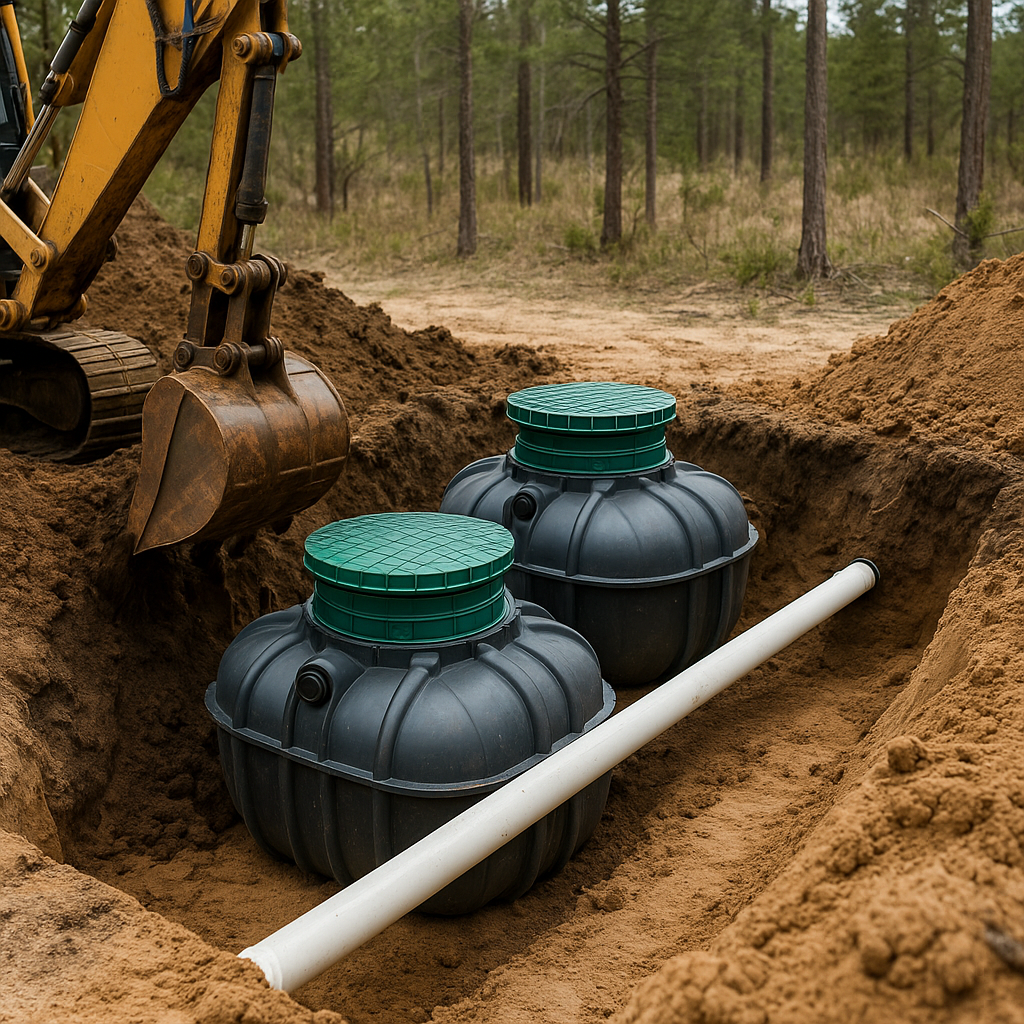
- Septic tank (1,500–2,000 gal): $2,800–$5,500 installed (concrete, traffic-rated lids add cost)
- Pump chamber & controls (if needed): $2,200–$4,800
- Tertiary treatment unit (as specified): $12,000–$25,000+ installed
3) Disposal Bed/Field
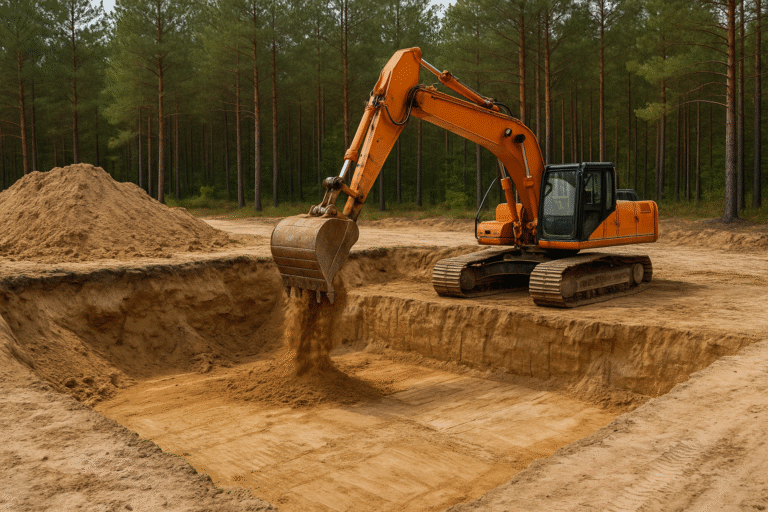
- Conventional in-ground or shallow buried trench: $8,000–$18,000
- Raised bed (imported sand/stone, more excavation): $14,000–$28,000
- Chambers vs. pipe-and-stone: usually similar totals; chambers can save labour on some sites.
4) Sitework & Restoration
- Clearing, stumping, stripping, access building: $1,500–$8,000+
- Rock excavation/blasting (if needed): can add $5,000–$30,000+
- Backfill, grading, topsoil, seed: $1,200–$6,000
🧪How soils & groundwater change your price
Your soil type and seasonal high water table determine bed sizing, elevation, and whether you need pumps or tertiary treatment. Here’s the short version:
| Site Condition | Typical Impact on Cost | Why It Happens |
|---|
| Clean sand, low groundwater | Most economical: $18k–$28k for simpler systems | Good percolation means smaller bed and no raising/pumping. |
| Clay/silt or variable fill | +$4k–$12k | More imported sand/stone, larger bed area, careful grading. |
| High water table/near shore | +$8k–$25k (raised bed, pumps; sometimes tertiary) | Maintain separation from groundwater; protect water quality. |
| Bedrock at shallow depth | +$6k–$30k | Rock breaking/blasting or extensive raising and import. |
🏠What size of system do I need (and how does that change cost)?
In Ontario, residential system sizing is based on number of bedrooms, fixtures, and daily design flow—not your best intentions to “shower less at the cottage.” More bedrooms and luxury fixtures can push tank size and bed area up. Typical single-family scenarios:
- 2–3 bedroom cottages: Smallest tanks we install are usually 1,500 gal; bed sizing depends on soil. Budget $20k–$35k on straightforward inland lots.
- 3–4 bedroom homes: Expect $25k–$45k depending on soils, pumps, and finish expectations.
- Luxury homes or high-fixture counts (multiple showers, whirlpools, etc.): Tanks, pumps, and bed areas get bigger; allow $35k–$65k+ especially on constrained or waterfront sites.
🚧Cost scenarios (realistic Georgian Bay examples)
Scenario A — Inland lot with good sand
3-bedroom bungalow, conventional gravity system.
- Design + permits: $2,800
- 1,500 gal concrete tank: $3,600
- In-ground pipe-and-stone bed: $10,500
- Excavation, import, restoration: $5,000
- Estimated total: $21,900 + HST
Scenario B — High water table near the Bay
4-bedroom home, raised bed + pump chamber.
- Design/soils (more detailed): $4,200
- 1,800–2,000 gal tank + pump chamber: $8,800
- Raised bed with imported sand/stone: $20,500
- Electrical, alarms, panel: $2,000
- Grading/topsoil/seed: $3,200
- Estimated total: $38,700 + HST
Scenario C — Waterfront + tertiary treatment
3-bedrooms, sensitive location with higher effluent quality requirement.
- Design/engineering, sampling plan: $4,800
- Tank + tertiary treatment unit + pump: $22,000
- Shallow buried trench/raised hybrid: $18,000
- Power, alarms, controls, startup: $3,200
- Landscaping/restoration/drive repair: $4,000
- Estimated total: $52,000 + HST
🧱What’s actually included in a “full system” price?
When you get quotes, make sure apples are apples. A proper quotation should spell out:
- BCIN design drawings and soils/testing info used to size the system.
- Tanks (size, material, traffic rating), risers and lids brought to grade, and effluent filter.
- Pumps & controls (model, flow rate, control panel, alarm) if needed.
- Distribution system (manifolds, valves, inspection ports), bed media (sand spec, stone size), and geotextiles.
- Excavation, import/export, trucking, final grading, and site restoration.
- Electrical to the pump chamber/control panel (licensed electrician) when applicable.
- Permits, inspections, as-built (who handles each step).
🪓Hidden costs and “gotchas” we see all the time
- Rock where no one expected it: A one-hour rock hammer rental is never one hour. If your neighbour hit rock, budget a contingency.
- Long material hauls: Some sites require 10–20 loads of sand/stone—trucking adds up fast.
- Old tanks or lines to be decommissioned: Pump-out, crush, fill, and dispose—budget a line for it.
- Driveways, patios, decks in the way: Demo and replacement are extras unless listed.
- Frost protection/insulation: Long pipe runs or shallow covers may require insulation or heat tracing.
- Access constraints: If we need a smaller machine and more trips, labour goes up.
📐How we price a septic job—step by step
- Discovery call & map study: We review your lot, services, and any known constraints.
- Site visit & test pits: Identify soils, bedrock, and water table; choose likely bed location.
- Concept & budget: We outline system type and a realistic range so you can plan.
- BCIN design & permit application: Drawings, specifications, and submission to the Health Unit/Building department.
- Build: Excavation, tanks, bed/trenches, plumbing tie-ins, electrical, inspections.
- Final grading & documentation: As-built info and handoff.
🧰Line-item cost guide (rule-of-thumb ranges)
| Component | What It Covers | Typical Range (CAD) |
|---|
| Design & Permits | Soils, sizing, BCIN drawings, submissions | $2,500–$5,500 |
| Septic Tank | 1,500–2,000 gal concrete with risers/lids | $3,000–$6,000 |
| Pump Chamber | Concrete tank, submersible pump, floats, risers | $2,200–$4,800 |
| Controls & Alarm | Panel, audible/visual alarm, wiring to chamber | $1,200–$2,500 |
| Distribution | Manifolds, valves, inspection ports, piping | $1,200–$3,000 |
| Bed Media | Clear stone, filter sand to spec, geotextile | $3,500–$10,000 |
| Excavation & Backfill | Machine time, operator, trucking | $4,000–$12,000 |
| Tertiary Treatment (if required) | Unit, installation, commissioning | $12,000–$25,000+ |
| Restoration | Fine grade, topsoil, seed/sod, driveway fixes | $1,200–$6,000 |
🌊Waterfront realities (and why they cost more)
On or near the Bay, the design must protect groundwater and surface water. That often means:
- Raised or shallow systems to maintain vertical separation from groundwater.
- Pumping to dose the bed evenly and keep it elevated.
- Tertiary treatment if required by the authority having jurisdiction.
- More inspections and documentation, plus careful restoration to control erosion.
None of this is optional when it’s prescribed; building it right the first time is cheaper than fixing it later—ask me how I know.
🧮Rapid budget worksheet (so you can sanity-check quotes)
Grab a pen; this will get you in the ballpark:
- Start with a base: $18,000 (inland, decent soils, gravity).
- Add for soil challenges: clay/fill +$4,000–$10,000; high water table +$8,000–$15,000; shallow bedrock +$6,000–$30,000 (if blasting).
- Add for pumping: chamber + controls +$3,000–$6,000.
- Add for tertiary treatment: +$12,000–$25,000.
- Design/permits: +$2,500–$5,500.
- Restoration/access: +$1,500–$6,000 (more if drive/landscaping are extensive).
If your math lands under $20k for a new build near the Bay, double-check what’s missing.
🪙Where you can save—without shooting yourself in the foot
- Design it once, right: Re-designs cost time and money. A thorough soils day is the cheapest insurance you’ll buy.
- Keep access wide and dry: Good access reduces machine time and trucking detours.
- Use standard tank sizes and locally supported equipment: Fancy is fun until you need a part on a long weekend.
- Plan the house plumbing smartly: Shorter runs and logical outlet locations mean less trenching and frost protection.
- Protect the bed area during construction: No parking, no materials stockpiled—compaction ruins performance and budgets.
⚖️Raised bed vs. in-ground vs. shallow buried trench
In-ground is the cheapest when soils and groundwater allow. Raised beds cost more due to imported media and labour but are often mandatory in high-water areas. Shallow buried trenches can be a nice middle ground with controlled dosing and smaller footprint, but you’ll likely need a pump and controls.
⚡Electrical, alarms & cold-weather details
- Dedicated circuit to the control panel: budget an electrician line item; GFCI/ARC and distances matter.
- Audio/visual alarm for high level—cheap protection against surprises.
- Frost considerations: Insulate shallow runs; long laterals might require heat tracing (materials + hydro).
🧱Materials & specs that matter (and keep inspectors smiling)
- Filter sand meeting the specified gradation, not “whatever the pit had that day.”
- Clear stone (washed), correct size.
- Non-woven geotextile between stone and cover material to prevent fines migration.
- Inspection ports and valves where required—future you will thank present you.
- Risers to grade for tank access. If you’ve ever dug for a lid in November, you know why.
🧭Permits, setbacks & who says “yes”
In Ontario, Class 4 systems fall under the Ontario Building Code and are reviewed/inspected by the local authority (often the Health Unit or municipal building department). Setbacks to wells, property lines, and waterbodies apply and vary by well type and local policy. We handle design/permits and coordinate the inspections so you’re not stuck in acronym purgatory.
📝What we need from you to price accurately
- Address, legal description, or PIN so we can pull mapping and constraints.
- Number of bedrooms & fixture list (showers, tubs, extra kitchens, laundry locations).
- Any past septic info (as-builts, pump-outs, failures, locations).
- Access notes (gate widths, overhead lines, steep drives, soft areas).
- Preferred house location and any “must-save” trees or landscape features.
❓FAQ — Straight answers to the things homeowners actually ask
- How long does a new install take?
- Once permits are in hand, most installs are 3–7 working days, plus a little time for inspections and restoration. Complex/waterfront systems take longer.
- Can I choose where the bed goes?
- We’ll try, but the final location respects setbacks, soil conditions, elevations, and access. Gravity is free; pumps are not.
- Do I need a pump?
- If the house outlet is lower than the bed elevation, or if the design calls for timed dosing/flow equalization, yes. Pumps add cost but also control and reliability.
- What if I plan a future addition?
- Tell us now. We can size the system to suit your future self, which is cheaper than “surprise renovations.”
- We’re right on the water. Is tertiary treatment guaranteed?
- It depends on soils, setbacks, and the authority having jurisdiction. Many waterfront sites do require advanced treatment and raised beds—budget for it until design proves otherwise.
- Winter install or wait for spring?
- We install year-round. Winter adds cost (frost, snow handling, material heating) but sometimes it’s the only window you’ve got. We’ll price both ways if timing is flexible.
- Can you reuse my old tank or bed?
- Only if it meets current code, capacity, and condition. Most replacements are full tear-outs—it’s safer and often cheaper long term.
🧭Your next steps (simple and painless)
- Send us your address and a quick sketch of where you picture the house and driveway.
- We’ll walk the site, dig a couple of test pits, and tell you what the lot wants to do.
- We’ll give you a fixed design fee and a clear budget range for the build.
- You decide; we handle the red tape and the digging.
Bottom line: For most Georgian Bay builds, plan on $22k–$45k for a standard system. Waterfront, high-water table, bedrock, or tertiary treatment push totals higher. Good design and careful site planning save the most money—every time.
P.S. We build the whole package—design, permits, excavation, tank, bed, electrical, inspections, and restoration—so you don’t play foreman between five contractors. If you already have drawings, we’re happy to price those too.